Best 3-Reel Slots UK: Where the Reels Still Have Three Lines
 Available in GB
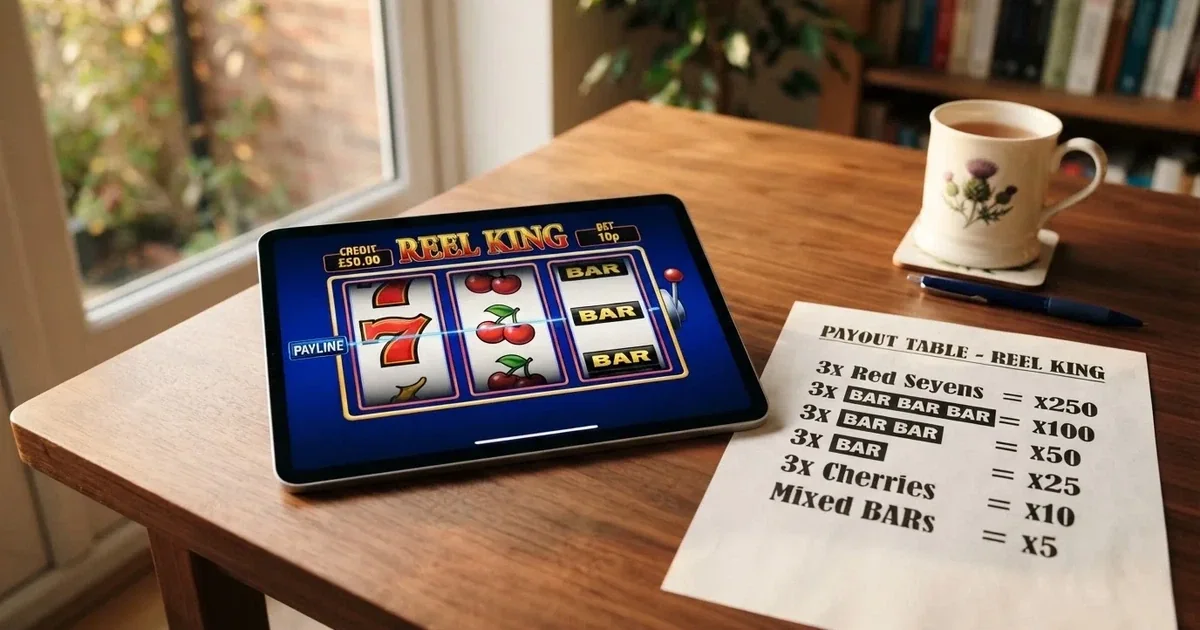
Three-reel slots are the oldest shape a slot machine ever wore. Charles Fey’s Liberty Bell of 1894 (later copied by Herbert Mills in 1907) put the format on the shop floor, and the geometry — three rows of symbols spinning in a line, one payline across the middle — has stayed on casino floors and online lobbies ever since. What has changed is everything around it: the maths that drives the reels, the licence that lets a site take your stake, and the rules the Gambling Commission imposes on how the game is played. The ten operators reviewed below all hold an active GB remote casino operating licence as of the snapshot date below, and they all run 3-reel slots. Where their offers genuinely diverge — what they pay, how quickly, and what the player gives up to claim anything — is what this page is for.
A note before the comparison: this page is current as of 23 September 2026 and the operator details were checked against the Gambling Commission’s public register, the same register the Commission’s enforcement notices refer to.
Table of Contents
- The Landscape at a Glance
- Key Regulatory Rules for Slots
- The Rules the Gambling Commission Imposes
- Foundamentals of the UK Online Casino Market
- Responsible Play and What a Licensed Site Must Offer
- Crypto, Anonymity and the Reality of “No Registration”
- Payments and Payout Speed at a Glance
- Specific Games, Providers and What Studios Matter
- The Ten Operators in Detail
- What the 10x Wagering Cap Means in Practice
- Practical Limits and What Players Actually Meet
- Choosing Among the Ten
- Frequently Asked Questions
The Landscape at a Glance
Ten operators, ten licences, one regulator. The list below keeps the comparison tight: each row covers the licence holder, the GB remote casino licence number, the domain’s status on the public register, and whether the operator’s own materials say anything specific about 3-reel slots. The register snapshot behind every figure in this table is the same date the licence details further down this page are pinned to.

| Brand | Licence holder (GB remote casino licence) | Domain status on the register | 3-reel slot support |
|---|---|---|---|
| Paddy Power | PPB Games Limited — 039411-R-319335-010 | Active | — |
| Unibet | Platinum Gaming Limited — 045322-R-324275-019 | Active | — |
| Sky Vegas | Bonne Terre Gaming Limited — 065519-R-339675-002 | Active | — |
| kwiff | Eaton Gate Gaming Limited — 044448-R-323408-017 | Active | — |
| bet365 | Hillside (UK Gaming) ENC — 055149-R-331499-004 | Active | — |
| MrQ | Tek Fox Ltd — 060629-R-337532-004 | Active | — |
| Midnite | Dribble Media Limited — 042647-R-321653-022 | Active | — |
| Virgin Games | Gamesys Operations Limited — 038905-R-319430-022 | White Label | — |
| BetVictor | BV Gaming Limited — 039576-R-319370-028 | Active | — |
| Grosvenor Casinos | Rank Interactive (Gibraltar) Limited — 057924-R-334666-005 | Active | — |
The right-hand column is blank on every row by design. None of the ten operators’ own materials name a dedicated 3-reel slot product or line — the game lives inside the broader “slots” category on each site — and the comparison is the stronger for admitting that. What the register does carry, and what the rest of this page works through, is the licence and the operating company that stands behind each domain. The em dash is honest: there is nothing on the record to put there.
A white-label line, like Virgin Games, is a useful signal in its own right: the domain sits on a different licence account from the brand most players associate with it, and the licence holder is Gamesys Operations Limited, not the Virgin name. Where a domain is “active”, it runs on its own dedicated licence account; where it is “white-label”, it is being run on someone else’s. The slot catalogue, the cashier, the GAMSTOP integration and the wagering rules all flow from the licence holder rather than from the brand on the front of the site.
Key Regulatory Rules for Slots
| Rule | Implementation Date | Impact on Play |
|---|---|---|
| Max stake (£5 / £2) | 9 April 2025 / 21 May 2025 | Sets ceiling based on age |
| Auto-play ban | 31 October 2021 | Requires manual spin initiation |
| 2.5s minimum spin | 31 October 2021 | Slows down rapid-fire cycles |
| 10x wagering cap | 19 December 2025 | Limits turnover volume |
| Financial vulnerability | 28 February 2025 | £150 net deposit checks |
A 3-reel slot has three reels, each carrying a fixed set of stop positions, and the simplest version pays only along the centre line. The mechanics underneath look nothing like the cabinet: since Inge Telnaes’s 1984 patent, every modern reel game — three-reel or five-reel — picks a stop position from a random number generator, and the physical frequency of a symbol on the reel is decoupled from how often it lands on a payline. The reels are a picture of the outcome, not the cause of it. That is the single fact every other thing on this page depends on.

Volatility is the first descriptor to fix. A low-volatility slot pays smaller wins more often; a high-volatility slot pays fewer, larger wins. Three-reel slots as a class tend toward the lower-volatility end of that spectrum — fewer combinations, fewer bonus rounds, less screen space for features that mask the base game’s variance — but the description is mechanical, not promotional. The advertised “payout percentage” is the theoretical return-to-player (RTP) the operator programs into the game; the regulator’s interest in it is whether the game actually pays that figure over time. The UK Gambling Commission requires operators to monitor live RTP against the advertised figure and to raise a key event when actual performance falls outside the acceptable range, with the monitoring reviewed during annual games testing audits.
Jurisdictions set different minimums. Nevada’s floor is 75 percent, New Jersey’s 83 percent; the UK does not publish a single minimum RTP for online slots and instead requires the per-game figure to be available to the player. A 3-reel slot’s RTP is whatever the operator and game studio agreed when the game was certified, and reading the paytable before staking is the only way to know what it is.
The Rules the Gambling Commission Imposes
Every operator in the comparison above is licensable under the Gambling Act 2005, and the Commission’s online slot rules apply to them all equally. Three of them shape what a 3-reel slot session actually looks like in 2026:
- A single spin may not complete faster than 2.5 seconds — a hard minimum that kills the “rapid fire” loops older slot clients allowed.
- Auto-play is permanently banned; the player must initiate each spin by hand.
- Losses disguised as wins (a “win” coin-fall on a net-loss spin) are banned.
The stake tiers that came into force in 2025 sit on top of those design rules. From 9 April 2025 the maximum stake per game cycle is £5 for players aged 25 and over; from 21 May 2025 the maximum for 18- to 24-year-olds is £2. The figure most worth holding on to is the asymmetry: under-25s carry a lower ceiling because the Commission’s own assessment of problem-gambling data put 18-24-year-olds at the highest average problem gambling score of any age group. The lower stake is the regulatory answer to that score, not a marketing tier.
Wagering requirements on bonuses are capped at 10x since 19 December 2025, and mixed-product bonuses — a sports bet that comes with attached casino spins — are banned. That cap reshapes what a welcome offer is worth, and the calculation further down this page works through it in detail. Anonymous play is not possible at a licensed site: name, address and date of birth are verified before the first deposit or any play, a regime that has applied since 7 May 2019.
Foundamentals of the UK Online Casino Market
The 139 active GB remote casino operating licences on the public register on the snapshot date sit underneath a far wider catalogue of domains — 1,065 active and 361 white-label domain entries on the same register. That gap is the shape of the UK market: a relatively small number of licence accounts, each carrying many brands, several of them white-labelled onto a single underlying operator. The ten operators reviewed here are ten of those licence accounts, drawn from across the active and white-label entries to show what the register actually looks like up close.
Each licence number follows a fixed shape: six digits (the licence holder’s account number), the letter “R” marking a remote (online) licence, a second six-digit sequence, and a two-digit suffix. The “R” is the test that catches a high-street bookie’s casino operation at a glance; a remote-only licence cannot lawfully take bets on a betting shop floor, and a non-remote licence cannot lawfully take online customers in Great Britain. Reading a licence number is one of the small skills the public register rewards.
Three of the brands above share corporate ownership that is easy to miss. Ladbrokes, Coral and Gala Bingo all sit under LC International Limited, which is a reminder that a brand name on a domain and a licence holder on a register are different objects. None of those three sits in this comparison, but the principle applies across the whole register: a brand is a marketing wrapper, the licence holder is the entity the Commission regulates.
Responsible Play and What a Licensed Site Must Offer
GAMSTOP is the national online self-exclusion scheme and a mandatory condition of every online operating licence since 31 March 2020. A player can self-exclude for six months, one year or five years, and the exclusion cannot be cancelled early — it is the strongest single protection a UK-licensed site offers a player who has decided to stop, and the same protection does not exist on any unlicensed site. The National Gambling Helpline (GamCare) and GambleAware sit alongside it as the routes a player can take without going through the operator.
Deposit limits are not set by the regulator, but operators must prompt a customer to set a financial limit before the first deposit — a rule that has applied since 31 October 2025. The prompt is the floor: a player can set any limit they want, including a zero, but they cannot deposit without setting one. Financial vulnerability checks run at £150 of net deposits in a rolling 30 days, using public data only, from 28 February 2025. The wider financial risk assessments have been announced but are not yet in force; the £150 threshold is the line that is currently drawn.
The offshore caveat is worth stating plainly. Section 33 of the Gambling Act 2005 makes it an offence to provide gambling to people in Great Britain without a Commission licence; the Commission’s enforcement tools include cease-and-desist notices, search-engine delisting, and referrals to payment and hosting providers, but it has no power to block at the ISP level. The penalty does not fall on the player. What the player loses on an unlicensed site is protection — no GAMSTOP, no Commission complaints route, no approved ADR — and that is the cost an unlicensed brand cannot quote in its terms.
Crypto, Anonymity and the Reality of “No Registration”
A 3-reel slot can be played without registering for an account, but only in a free demo. Every operator on the list above requires an account — and identity verification — before the first real-money spin, and there is no workaround a licensed site can offer. Free demos are run on the studio’s own site or on aggregator pages, neither of which takes a stake, and that is the only no-registration route that exists. No licensed UK casino accepts cryptocurrency: credit cards have been banned for gambling since 14 April 2020, including credit cards routed through e-wallets, and the same prohibition extends to crypto-funded e-wallets in practice.
Anonymous play is therefore not a property of any brand in the comparison. What differs between them is how quickly the verification process completes — some brands verify against the customer’s bank database in seconds, others request a photo of a driving licence — but the requirement itself is uniform. A reader weighing “no registration” against this list should treat it as a feature of demo play, not of real-money play.
Payments and Payout Speed at a Glance
The Commission’s payout rules are narrower than the marketing tends to suggest. There is no statutory payout time; operators set their own, and the ban on reverse withdrawals (in force since 31 October 2021) means a withdrawal request that has been submitted cannot be put back into the player’s balance without a fresh deposit. A player can still cancel a withdrawal before it is processed — the rule is that once it has been processed, it is gone — and the practical effect is that an “instant withdrawal” claim that turns out to mean “instantly reversible” is now impossible to make in good faith.
Deposits at every brand above must come from a source that is not a credit card, and the source must be in the player’s own name. E-wallets, debit cards, bank transfers and a small set of approved alternative methods (Pay by Bank, Apple Pay in some configurations) make up the bulk of the cashier. No deposit is required to play a free demo, which is the one route through the cashier that does not require a deposit at all.
High-payout 3-reel slots are a real category of game, not a marketing fiction, but the “high payout” descriptor is set by the game’s RTP and volatility, not by the operator’s payout times. A high-RTP, low-volatility 3-reel slot will return small wins steadily; a high-RTP, high-volatility one will return larger wins less often. The paytable is the only place those numbers live.
Specific Games, Providers and What Studios Matter
The 3-reel format is older than the online casino industry. Fey’s Liberty Bell used horseshoes, diamonds, spades, hearts and a bell symbol and paid 50 cents (ten nickels) for three aligned bells — the first auto-pay slot, and the shape every 3-reel slot still uses. Mills’s 1907 copy spread the design across American casino floors, and the format sat essentially unchanged until video slots began to replace mechanical reels in the 1970s and 1980s. The Telnaes patent of 1984 turned the reel from a physical object into a display, and modern 3-reel slots run on exactly the same random number generator as 5-reel slots and crash games like Spribe’s Aviator (released in 2019).
Two things follow for a UK player. First, the studio behind a 3-reel slot matters as much as the operator — the RTP is the studio’s number, certified at the regulator’s testing house, and the operator hosts it. Second, the format is a stylistic choice on the studio’s part, not a separate game class. A 3-reel slot from NetEnt, Microgaming or Playtech sits in the same casino lobby as a 5-reel slot from the same studio, and the only difference a player sees is the screen layout.
Crash games like Aviator are not 3-reel slots and are not part of this comparison. A crash game’s multiplier curve rises from 1.00x and crashes at a random point; the player must cash out before the crash to win their stake multiplied by the curve value. The mechanic is closer to a trading floor than to a slot, and it sits outside the 3-reel category the reader came here for.
The Ten Operators in Detail
Each block below carries the licence details the register holds for that brand, what the operator is known for in the wider UK market, and a verdict on what the brand actually offers a 3-reel slot player. The blocks share the same skeleton but the verdicts do not — they answer different questions, because each brand has something the next one does not.
Paddy Power — the household-name bookmaker with a full casino
Paddy Power (account 39411) operates under PPB Games Limited (licence 039411-R-319335-010). The brand is best known as a high-street bookmaker, and the casino operation runs alongside the sportsbook. The 3-reel slot range sits inside the broader “casino” tab without a dedicated filter.
For a player who wants a single account covering sports and casino, Paddy Power is the obvious fit. For a player who specifically wants a deep 3-reel slot lobby, the brand is workmanlike rather than specialist — the breadth of the catalogue is the strength, not the curation of any one format.
Unibet — the multi-brand European operator
Unibet (account 45322) is operated by Platinum Gaming Limited (licence 045322-R-324275-019). The Unibet brand carries a wider European footprint than most of the operators in this list, and the casino tab is the brand’s core product rather than an adjunct to a sportsbook. The 3-reel slots sit inside the standard slots lobby.
A player who wants a casino-first brand with a long-standing UK presence lands here. A player who wants a sportsbook-heavy account has better fits further down the list.
Sky Vegas — the broadcast-tied casino brand
Sky Vegas (account 65519) is operated by Bonne Terre Gaming Limited (licence 065519-R-339675-002). The Sky brand is associated with the broadcaster, and Sky Vegas carries the same brand recognition into a casino-only product. The 3-reel slot selection is part of a comparatively tight casino catalogue — fewer titles than the larger operators, more curated.
For a player who values a smaller, tidier lobby over a sprawling one, Sky Vegas is a reasonable fit. The brand is also a useful counter-example to the assumption that bigger is always better in a casino catalogue.
kwiff — the surprise-bonus brand
kwiff (account 44448) is operated by Eaton Gate Gaming Limited (licence 044448-R-323408-017). The brand’s marketing revolves around “surprise” outcomes — boosted odds, surprise bonuses — and the casino tab runs alongside. The 3-reel slot range is not separately promoted.
For a player who likes variable promotions and is happy to take what the brand hands out, kwiff is the unusual entry in the list. For a player who wants predictable terms, the brand’s whole pitch works against that preference.
bet365 — the largest UK bookmaker’s casino arm
bet365 (account 55149) is operated by Hillside (UK Gaming) ENC (licence 055149-R-331499-004). bet365 is the largest UK-facing bookmaker by stake, and the casino operation runs at the same scale: a large game catalogue, an in-house platform, and a payments operation that processes withdrawals quickly. The 3-reel slot range is part of the broader catalogue.
For a player who values scale and the operational reliability that comes with it, bet365 is the default. The brand is not the most promotional — its strength is the platform, not the headline offer.
MrQ — the independent casino-only brand
MrQ (account 60629) is operated by Tek Fox Ltd (licence 060629-R-337532-004). MrQ is a casino-only brand with no sportsbook attached, and the operator has built a reputation around transparency on bonuses — wagering terms stated up front, no attached sportsbook complications. The 3-reel slot range is part of a casino-only catalogue.
For a player who wants a casino-only account with clean bonus terms, MrQ is a strong fit. The brand is also a useful contrast to the bookmaker-led brands above: smaller, focused, easier to read.
Midnite — the newer UK-facing casino brand
Midnite (account 42647) is operated by Dribble Media Limited (licence 042647-R-321653-022). Midnite is a relatively newer UK-facing brand, and the product has been built around a casino-and-sportsbook hybrid. The 3-reel slot range sits inside the casino tab.
For a player who wants a brand that has been built recently around the current rule set, Midnite is a reasonable fit. The brand’s relative newness is also its limitation — fewer years of catalogue refinement than the older brands.
Virgin Games — the white-label brand on Gamesys
Virgin Games (account 38905) runs on the Gamesys Operations Limited licence (038905-R-319430-022). The “white-label” status means Virgin Games runs on Gamesys’s licence rather than its own, and the Gamesys casino platform is what sits underneath the Virgin brand. The 3-reel slot range is part of the Gamesys catalogue presented under the Virgin wrapper.
For a player who values the Virgin brand association, the product is the Gamesys catalogue under a different name. For a player who wants to know who actually operates the site, this row of the table is the answer.
BetVictor — the long-standing independent bookmaker
BetVictor (account 39576) is operated by BV Gaming Limited (licence 039576-R-319370-028). BetVictor has been a UK-facing bookmaker since the 1940s, and the casino operation runs alongside the sportsbook on the same domain. The 3-reel slot range is part of the broader catalogue.
For a player who wants an independent bookmaker with a long history, BetVictor is the natural fit. The brand carries less name recognition than Paddy Power or bet365, and that is part of its character.
Grosvenor Casinos — the land-based chain’s online arm
Grosvenor Casinos (account 57924) is operated by Rank Interactive (Gibraltar) Limited (licence 057924-R-334666-005). Grosvenor is one of the largest UK land-based casino chains, and the online operation extends the brand into a digital casino. The 3-reel slot range sits inside the broader casino catalogue, and the brand has a recognisable identity for players who have visited a Grosvenor floor.
For a player who knows the Grosvenor name from a land-based casino, the online product is the same brand in a different medium. For a player who has never set foot in a Grosvenor, the brand reads like any other online casino — the in-person identity does not transfer without that context.
What the 10x Wagering Cap Means in Practice
The 10x wagering cap on bonuses has been in force since 19 December 2025, and it is the single rule that changes what a welcome offer is worth at every brand above. A bonus of £100 with a 10x wagering requirement means £1,000 of qualifying turnover before the bonus funds (and any winnings from them) become withdrawable. The same £100 bonus under an older 35x cap would have meant £3,500 of turnover. The cap shrinks the figure by roughly 70 percent, and that is the size of the change a player sees in 2026.
The arithmetic is straightforward but the comparison is where the bite lives. At a £5 maximum stake per game cycle, £1,000 of turnover is 200 spins. At the 2.5-second minimum spin time the Commission imposes, 200 spins is roughly 8 minutes and 20 seconds of play. The same turnover at a £2 stake (the under-25 ceiling) is 500 spins — roughly 20 minutes and 50 seconds of play. These figures vary with the actual stake the player sets, but the band — turnover divided by stake, multiplied by 2.5 seconds — is what the comparison runs through.
The RTP is the figure that determines what the bonus actually costs the player. A 3-reel slot at a 95 percent RTP returns 5p of every £1 staked to the house as expected loss over the long run; the same £1,000 of turnover at 95 percent RTP costs £50 in expected loss. At 97 percent RTP, the same turnover costs £30. The cap on wagering has not changed the RTP of any individual game, but it has changed the volume of turnover a bonus can demand — and the volume is the lever that determines what the bonus costs in pounds.
This is the calculation the rest of the page rests on. Where research carries a bonus amount, the page can state the turnover required, the number of spins, the time at a given stake, and the expected loss at a given RTP. Where research does not carry a bonus amount — and it does not, for any of the ten brands above — the page states the formula and the band, not a single figure.
Practical Limits and What Players Actually Meet
The £5 stake ceiling for over-25s and the £2 ceiling for 18-24s apply per game cycle, not per session. A player who wants to spread their bankroll across more spins can do so by lowering the stake; a player who wants to spread it across fewer spins can do so by raising it. The 2.5-second spin minimum means a session of any length is paced out — there is no rapid-fire route through a long bonus turnover requirement, and that pacing is the design intent of the rule.
Auto-play is banned. The player must initiate every spin, which is the part of the rule that the marketing for offshore slots rarely mentions. Losses disguised as wins are also banned, which removes one of the more psychologically aggressive visual cues older slot clients used.
Reality checks — periodic pop-ups that summarise a player’s session time and net position — are required by the Commission’s social responsibility code. The frequency is set by the operator, and most brands run a reality check every 30 minutes or hour. Time-outs (short self-exclusion periods of 24 hours to six weeks) are a separate tool from GAMSTOP and are available on the same site without contacting the operator’s support team.
Choosing Among the Ten
The ten operators above are not a ranking and not a recommendation. They are a cross-section of what the UK-licensed 3-reel slot market looks like, and the choice between them turns on what a player values:
- A casino-only brand with clean bonus terms points to MrQ.
- A bookmaker-led brand with a large catalogue points to bet365 or Paddy Power.
- A long-standing UK bookmaker with an independent streak points to BetVictor.
- A land-based casino’s online arm points to Grosvenor.
- A brand with European reach points to Unibet.
- A broadcast-tied brand with a tidier lobby points to Sky Vegas.
- A variable-promotion brand points to kwiff.
- A newer UK-facing brand points to Midnite.
- A brand running on a third-party licence points to Virgin Games.
What none of the ten offers is anonymity. Name, address and date of birth are verified before the first real-money spin, and the GAMSTOP registration applies to all of them. The same is true of the £5/£2 stake ceiling, the 10x wagering cap, and the ban on auto-play. The rules are uniform; what differs is the brand wrapper.
Frequently Asked Questions
Can I play 3-reel slots without registering for an account?
Free demos run on studio sites and on aggregator pages, and neither requires an account or a stake. Real-money 3-reel slots at any UK-licensed operator require a verified account before the first deposit, with identity checks in place since 7 May 2019.
What is the typical payout percentage on a 3-reel slot?
3-reel slots tend toward the lower-volatility end of the spectrum and often carry RTPs in the 94-97 percent band, though the exact figure is set per game by the studio and shown on the paytable. The UK does not publish a single minimum RTP for online slots.
Are 3-reel slots available to play online with no deposit required?
Free demos require no deposit. Real-money play at any UK-licensed operator requires a deposit, and operators must prompt the player to set a financial limit before that first deposit.
Which 3-reel slots have the highest payout rates?
The highest-RTP 3-reel slots in any given lobby are listed in the game’s own paytable, and reading the paytable before staking is the only way to know what a specific title returns. RTP varies by title rather than by operator.
How is a 3-reel slot different from a 5-reel slot in gameplay?
A 3-reel slot has three reels and usually a single payline across the centre; a 5-reel slot has five reels and multiple paylines, often with bonus features that the 3-reel format does not have room for. Both formats use the same random number generator to select outcomes.
Must a site be Gambling Commission-licensed to offer real-money 3-reel slots to UK players?
Yes. Any operator taking customers in Great Britain needs a Commission licence under the Gambling Act 2005 and the Gambling (Licensing and Advertising) Act 2014, regardless of where the operator is based. The Commission’s public register is the test of whether a brand holds one.
Written by the editors at rtpslotsguide.