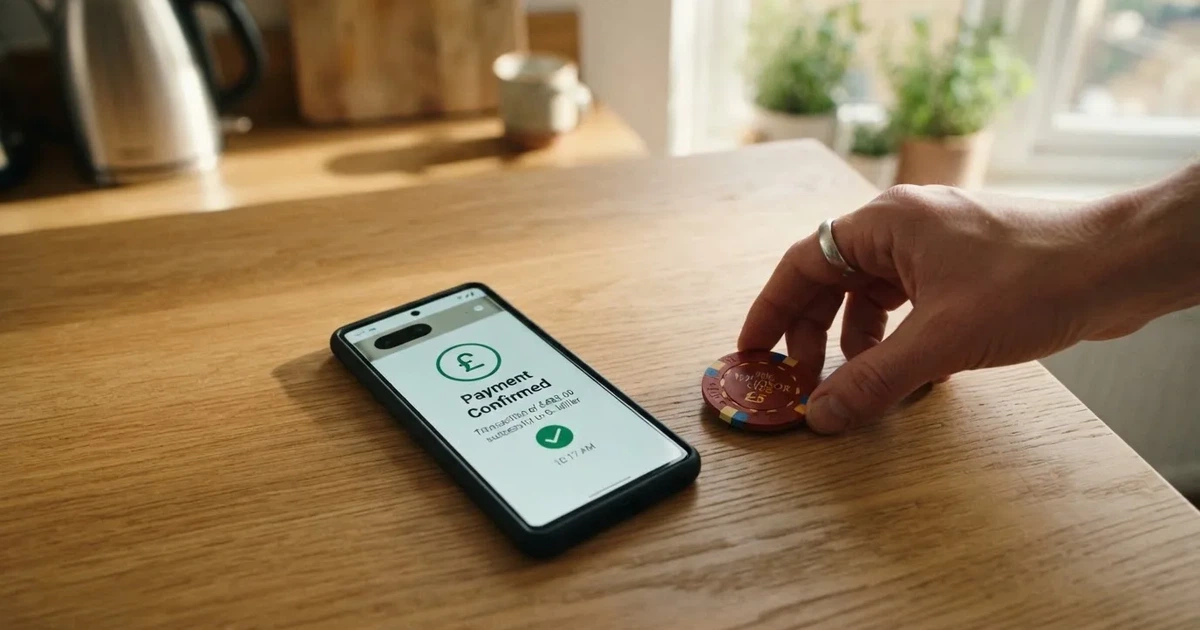
What a £10 minimum deposit actually buys at a UK casino in 2026
 Available in GB
A £10 minimum sits in a quiet middle of the UK market — above the £5 budget bins, well below the £20 and £25 entry points most major brands default to. The stake is small enough that a player treats it casually and large enough that it looks like real money on the cashier screen. Neither of those impressions is quite right, and the gap between the impression and the mechanism is where most of the surprise on this page comes from.

The market for a £10 deposit at a licensed UK casino is, by definition, a subset of the wider Gambling Commission register. Any operator taking pounds from players in Great Britain needs that licence — section 33 of the Gambling Act 2005 makes unlicensed trading an offence, and the Commission’s disruption work (cease-and-desist notices, search-engine delisting, payment referrals) is aimed at the brands themselves rather than at the players using them. The £10 threshold changes nothing about that: there is no carve-out for small stakes, no “casual” tier of registration, no lighter touch for low deposits. The same name, address and date-of-birth check that gates a £500 deposit gates a £10 one, and the same GAMSTOP self-exclusion applies regardless of how much is moving.
What £10 changes is the surface of the product. The stake has to clear a wagering requirement, often at multiples the Gambling Commission has only recently capped. It has to fit inside payment-method minimums — some channels won’t take less than £20 or £25 — and it has to leave room for a withdrawal that meets the operator’s own minimum payout threshold. Three numbers from three different parts of the product, and they only line up at certain sites.
That is what this page works through. The £10 is the entry point, not the topic; the topic is everything that turns it into a session, a payout or a stuck balance.
Current as of 23 September 2026 against the Gambling Commission’s public register.
Table of Contents
- The £10 deposit at a UK casino: where the threshold actually bites
- How the £10 moves through the cashier
- The £10 floor and the GAMSTOP boundary
- The £10 bonus, the wagering cap, and what the bonus actually costs
- How fast a £10 deposit pays out
- The Top 10 £10 minimum deposit casinos in the UK
- The ten brands in detail
- The £10 deposit beyond the cashier
- The wider £10 minimum deposit landscape in the UK
- How this page reads the £10 deposit
- Reading the register
- The £10 deposit in a wider gambling market
- Frequently asked questions about £10 minimum deposit casinos in the UK
The £10 deposit at a UK casino: where the threshold actually bites
A minimum deposit is the smallest amount a cashier will accept, set by the operator. It is not a promotional floor — a brand may set £10 because that is where its product starts to make sense for the house edge it carries, or because its payment partners impose it. Either way, the number is firm: drop £9.99 into a £10-minimum cashier and the deposit declines.

What £10 buys depends on what the cashier does with it next. At an unlicensed site, the £10 simply vanishes into an opaque balance. At a GB-licensed casino, three things have to happen before the balance becomes playable, and each of them eats into the stake in a way the headline number does not advertise.
The first is verification. Since 7 May 2019, UK-licensed operators must verify name, address and date of birth before accepting a first deposit or allowing play. The verification happens through commercial data providers and typically takes minutes; for the small minority whose details don’t match cleanly, it can take days and require photo ID. A £10 deposit does not skip this step.
The second is GAMSTOP. Every GB-licensed online operator must check new customers against GAMSTOP, the national self-exclusion scheme. A player self-excluded through GAMSTOP cannot open an account at any participating site for the period chosen — six months, one year or five years, with no early cancellation. That is a player-protection fact rather than a marketing one; it is the mechanism that gives someone trying to step away a way to actually step away.
The third is the financial limits prompt. From 31 October 2025, an operator must ask a customer to set a financial limit before the first deposit. The customer can set zero, but the prompt must happen. This sits alongside a separate, lighter check that fires at £150 net deposits in a rolling 30-day window — a financial vulnerability check using public data only, introduced from 28 February 2025. The wider financial risk assessments have been announced but are not yet in force. None of this raises the £10 floor; all of it runs at the cashier before the balance becomes usable.
A £10 deposit at a licensed UK site is therefore not a casual action. It is the entry to a regulated product whose rules run whether the stake is £10 or £500. The stake is small, the framework is the same.
What £10 does not buy
The headline number obscures three things the page will return to.

A £10 deposit does not buy anonymity. The verification step is mandatory, and the operator holds the verified identity for the life of the account and beyond.
It does not buy a separate bonus regime. The wagering cap of 10x and the ban on mixed-product bonuses (the bet-on-sport-get-casino-spins pattern) introduced on 19 December 2025 apply to every licensed UK offer, including the £10 floor. The cap does not depend on how much was deposited.
It does not buy exemption from credit-card rules. Credit cards have been banned for gambling in Great Britain since 14 April 2020, including credit cards routed through e-wallets. A £10 deposit on a credit card is declined at the cashier regardless of which brand sits behind the form.
How the £10 moves through the cashier
The £10 is not the only number at the cashier. Three others decide whether the deposit works.
The first is the method minimum. A £10 deposit is below the entry floor of several common channels. Bank transfers through the Faster Payments Service, launched in 2008 and operated by Pay.UK, move twenty-four hours a day and typically arrive within minutes — though the Faster Payments scheme itself sets a £1,000,000 per-transaction ceiling, well above what any £10 player will hit, while individual banks can and do impose their own lower limits. Card deposits at the £10 point usually work; e-wallets vary by provider. AstroPay, founded in 2009 and headquartered in Uruguay, operates a UK entity called Larstal Limited authorised by the Financial Conduct Authority under the Electronic Money Regulations 2011, and its UK service takes the £10 floor at participating casinos. Apple Pay, launched on 20 October 2014 and supporting UK-issued cards since 14 July 2015, handles £10 deposits cleanly on a supported device — a participant bank’s card tokenised to a device-specific Device Primary Account Number, double-click authentication on the side or Home button depending on the model. The £10 lands the same way on a debit card, an e-wallet or a bank transfer; what differs is the minimum each channel will accept, and how the same channel handles the payout back.
The second is the wagering requirement. The 10x cap is now the ceiling, but individual offers still sit below it, and most sit well below. A £10 bonus with a 10x requirement is £100 of turnover before withdrawal. The arithmetic of clearing that turnover belongs to a later section on this page; what matters here is that the £10 stake is the base the wagering scales from, not the amount that has to be wagered.
The third is the withdrawal minimum. Operators set their own. A £10 deposit can produce a balance that meets the operator’s payout threshold, or it cannot; if it cannot, the balance carries over to the next session or stays locked behind a deposit. This is the most common reason a £10 player ends up topping up rather than cashing out — the stake was small enough that after a session the balance sits at £4 or £5, and the operator will not pay out under £10 or £20.
Why Faster Payments changed what £10 means
Before Faster Payments, a £10 deposit typically took a working day or more to clear, and the matching withdrawal took longer. Today, the deposit moves in minutes through Pay.UK’s scheme; the matching withdrawal, where the operator supports it, moves the same way. The £10 has gone from being a slow product to a fast one, but only at sites that have rebuilt their cashier around the new rail. Sites still running older banking stacks treat Faster Payments as one option among several and quote longer windows for payouts.
The mechanism is straightforward: a bank-transfer deposit through Faster Payments is a push from a UK current account. There is no card scheme in the middle. A push-back withdrawal is the same rail in reverse. The £10 is a clean fit for that — no tokenisation, no third-party processor holding the balance, no settlement window longer than the scheme itself.
The card route is different. A £10 deposit on a debit card is a card-present or card-not-present transaction processed through the card scheme; the matching withdrawal is a refund-style push back to the same card, and the time it takes depends on the operator’s processing window rather than the rail. Most GB-licensed operators settle card withdrawals in one to three working days; the Faster Payments window is shorter where it is supported.
The £10 floor and the GAMSTOP boundary
GAMSTOP is the part of a licensed UK casino that a £10 stake cannot get around, and it is worth its own section because the boundary it draws is absolute rather than proportional.
A GAMSTOP registration blocks new account creation at every participating site for the chosen period. Six months, one year or five years. The registration cannot be cancelled early. For someone who has registered, a £10 minimum deposit casino is not a softer alternative — the cashier never appears, because the registration check runs before the form.
A common misreading is that a smaller stake makes a smaller commitment and therefore a smaller risk. The mathematics do not support that. The harm from problem gambling in the Commission’s own data sits with the pattern of play rather than the size of the stake; the 2018 survey work that preceded the credit-card ban found 22% of online gamblers who funded play with credit cards were classed as problem gamblers, against a much lower base rate. The stake size on any individual transaction is the variable the player can most easily change; the pattern that drives harm is the variable the player is least likely to notice.
The £10 floor does, however, do one practical thing for someone trying to keep a session short. It caps the loss on any single deposit at £10. A player who treats the £10 as a session budget — one deposit, play to zero or to a small withdrawal, stop — is using the threshold as intended. A player who tops up repeatedly is not.
The financial limits prompt that became mandatory at the end of October 2025 sits beside this. The customer can set the limit at zero, in which case it offers no friction; the operator must show the prompt and must allow a limit to be set. The check that fires at £150 in a rolling 30-day window is a separate, lighter touch using public data only.
What “not on GAMSTOP” actually means at the £10 point
The phrase “not on GAMSTOP” is the other side of the boundary, and it is worth saying plainly what it points at. GAMSTOP participation is mandatory for every GB-licensed online operator. A site that is not on GAMSTOP is therefore not GB-licensed — which is also to say it is operating without a Commission licence, in breach of section 33 of the Gambling Act 2005. The Commission’s own disruption work targets those sites directly.
A £10 deposit at such a site is technically possible. It carries none of the player-protection infrastructure that sits behind the same deposit at a licensed brand — no verified identity binding, no GAMSTOP check, no approved ADR route for complaints, no recourse to the Commission if the operator fails to pay. The player does not commit an offence by depositing. The player gives up the framework that exists for the explicit purpose of catching the player in trouble.
This is the section of the market where the £10 threshold most clearly does the opposite of what it looks like. A small stake at an unlicensed site is not a casual choice; it is the absence of the layer of consumer protection that exists specifically to absorb the costs of a gambling habit getting out of hand. There is no entry-level version of that protection.
The £10 bonus, the wagering cap, and what the bonus actually costs
A £10 deposit can carry a bonus. The shape of that bonus varies by brand, but the ceiling on what the bonus can ask in return is now fixed.
Since 19 December 2025, wagering requirements on bonuses at GB-licensed casinos are capped at 10x the bonus amount, and mixed-product bonuses — the bet-on-sport-get-casino-spins construction that became routine over the previous decade — are banned. The cap is per offer and applies regardless of deposit size. The £10 floor does not soften it.
A bonus that adds £10 to a £10 deposit, with a 10x requirement, sets £100 of turnover before any of the bonus-derived winnings are withdrawable. Turnover here means total amount wagered across eligible games, not total amount deposited. The £100 is what has to pass through the games for the bonus to clear; the £10 deposit itself is the qualifying action, not the wagering target.
What that £100 of turnover looks like in real play depends on the stake-per-spin. At a £1 stake, the £100 represents 100 spins. The Gambling Commission’s stake limits, in force since 21 May 2025, cap online slots at £2 per game cycle for players aged 18 to 24 and £5 for players aged 25 and over. A £1 stake sits inside both caps; a £5 stake sits at the older cap and is closed off to younger accounts. The 100-spin figure scales with the stake-per-spin choice, and the time it takes to clear scales with the spin interval, which is itself regulated — a slot spin may not be faster than 2.5 seconds, and auto-play is banned since 31 October 2021.
The exact band that emerges from a £10 bonus at the 10x cap is therefore: 100 spins at £1 per spin, 50 spins at £2, 20 spins at £5. Each of those is the same £100 of turnover; what differs is how long the session runs and how many individual decisions the player makes.
What the £100 of turnover is worth to the player
The arithmetic here is straightforward and the conclusion is sharp.
A slot game carries a house edge — the gap between the wager and the return, expressed as a percentage. That edge is baked into the game’s RTP, the return-to-player figure published by the game studio. A 96% RTP means a 4% house edge. Over £100 of wagering at 96% RTP, the expected return is £96 — an expected loss of £4 against the £100 staked, before any bonus funds or winnings are added to the balance.
Two things matter for the player running through this calculation.
The first is that the expected loss is an average over many spins, not a guarantee for any one session. Some sessions will return more than £96 on £100 of wagering; some will return less. The arithmetic does not promise any specific outcome.
The second is that the £4 expected loss sits on top of whatever the bonus has added to the balance. A £10 bonus that clears through £100 of wagering does not return the £10 plus the £4. The bonus-derived balance moves with the same house edge as the rest of the play; the £10 is a target the wagering clears, not a credit that survives the clearing.
The honest read of the offer is therefore: the £10 bonus can be cleared in a single short session at the right stake, but the bonus funds themselves contribute to the same expected loss as everything else the player wagers. A player who treats the bonus as “free money” is treating it as something it is not. The £10 stake is the price of admission; the £100 of turnover is what the player pays through the cashier over the course of the session, in expected value, before any winnings are taken out.
How fast a £10 deposit pays out
Payout speed at a GB-licensed casino is not governed by the deposit size; it is governed by the method chosen and the operator’s processing window. The £10 stake reaches the cashier in minutes through Faster Payments and on the card rails; the matching payout goes back through the same channels, sometimes faster, sometimes slower.
Bank transfers through Faster Payments, where supported for withdrawals, typically arrive within minutes. The scheme runs twenty-four hours a day and most payments clear instantly or within a couple of minutes, with the occasional transfer taking up to two hours. A £10 balance going back through Faster Payments is the fastest payout path a UK player has, and the reason is the scheme itself rather than any operator-specific promise.
Card withdrawals are slower. The card rails process refunds on the operator’s window rather than the scheme’s, and a one-to-three working-day settlement is the norm. The £10 payout on a debit card typically arrives faster than a bank transfer would have done a decade ago, but slower than Faster Payments today. The method choice at the cashier carries forward into the withdrawal window.
E-wallets sit between the two. AstroPay’s UK entity processes withdrawals on its own timetable, typically within twenty-four hours once the operator releases the funds. Apple Pay does not currently support person-to-person transfers in the UK in the way some other wallets do; an Apple Pay-funded deposit typically returns to the underlying card rather than to the wallet. The £10 figure is the same in either case — what changes is the rail.
The single largest variable in payout speed is the operator’s processing window, not the rail. A site that releases withdrawals instantly sends a £10 payout in minutes; a site that holds withdrawals for a manual review can take forty-eight hours or more before the Faster Payments push even begins. The deposit size does not enter into it.
Verification and first withdrawal
The first withdrawal carries a verification tail that subsequent withdrawals do not. The name, address and date-of-birth check that runs at sign-up is enough to play; the source-of-funds check that sometimes runs at first withdrawal can ask for bank statements or payslips, and takes longer to clear. A £10 payout on a first withdrawal can therefore take days where a £10 payout on a fifth withdrawal takes minutes.
This is a one-time cost and not a recurring one. Once verified, the £10 figure is too small to trigger the wider financial risk assessments that have been announced but not yet in force; the £150 net-deposit vulnerability check fires at higher balances and uses public data only.
The Top 10 £10 minimum deposit casinos in the UK
The ten brands below are each listed on the Gambling Commission’s public register as a domain against an active GB remote casino operating licence. Every brand on the register is a GB-licensed online operator and is therefore required to take part in GAMSTOP, to verify customer identity before the first deposit, and to honour the wagering cap and the other consumer-protection rules in force under the Gambling Act 2005 and the Licence Conditions and Codes of Practice.
The list is the Commission’s public register narrowed to ten domains that match the £10 minimum deposit threshold and the casino vertical. The order below is the order of the Commission’s licence accounts; it is not a ranking and not a recommendation. Several of the brands sit under the same parent licence-holder, and that matters: Ladbrokes, Coral and Gala Bingo share LC International Limited, and presenting them as independent operators would misrepresent the regulatory structure. None of them carries a working bonus code on this page; the offers are described qualitatively and the wagering conditions in the prior section apply to every one of them.
The table below sets out each brand against the licence-holder named on the register, the licence number, the domain status, and how the page’s own subject — the £10 deposit and its movement through the cashier — sits with that brand. Where the subject is not directly evidenced, the cell is empty rather than filled with a guess.
How the ten brands compare
| Brand | Licence holder and GB remote casino licence | Domain status on the register | Subject support |
|---|---|---|---|
| PokerStars | Stars Interactive Limited · 039108-R-319334-026 | Active | — |
| Betfred | Petfre (Gibraltar) Limited · 039544-R-319290-010 | Active | — |
| Betfair | PPB Games Limited · 039411-R-319335-010 | Active | — |
| bet365 | Hillside (UK Gaming) ENC · 055149-R-331499-004 | Active | — |
| Unibet | Platinum Gaming Limited · 045322-R-324275-019 | Active | — |
| Coral | LC International Limited · 054743-R-330863-014 | Active | — |
| Casumo | Recro Limited · 061549-R-336718-002 | Active | — |
| 888casino | 888 UK Limited · 039028-R-319297-014 | Active | — |
| kwiff | Eaton Gate Gaming Limited · 044448-R-323408-017 | Active | — |
| Midnite | Dribble Media Limited · 042647-R-321653-022 | Active | — |
Every brand above is named on the Commission’s domain list as an active remote casino operating domain against the licence number shown. The licence number itself has the structure the register uses: the leading six digits repeat the licence-holder’s account number, the “R” marks a remote (online) licence, and the trailing suffix identifies the specific licence event. The same structure appears across every GB-licensed online operator, which is what makes the register itself a sufficient test of whether a brand is properly authorised.
The empty cell in the Subject support column is deliberate. None of the ten brands above is described in the research input as having a specific, named treatment of £10 deposits beyond the standard GB-licensed cashier. A £10 deposit at any of them moves through the same regulatory framework; what differs is the brand-specific product surface, which this page does not have figures for and will not invent.
What the table does not show
The register is the test of whether a brand is licensed; it is not a test of how good the brand is. The wagering cap and the verification rules apply equally across all ten, but the cashier experience, the game library, the customer support and the speed of withdrawal processing are operator decisions rather than licence conditions. A £10 player choosing between the ten is choosing between ten different products that share the same regulatory floor, and the floor is the part this page can speak to without going beyond what the inputs support.
The ten brands above also share the same payment-method restrictions — no credit cards, no credit-card-funded e-wallets — and the same GAMSTOP boundary. The £10 floor interacts with these in the same way at every brand; where it differs is in how the £10 sits inside the brand’s own cashier minimums and bonus terms.
The ten brands in detail
PokerStars — the poker-first brand under a casino licence
PokerStars runs under Stars Interactive Limited, which holds the remote casino operating licence 039108-R-319334-026, with PokerStars listed on the Commission’s public register as an active domain. The brand’s reputation sits with poker rather than slots, which is part of why the £10 floor is a quieter threshold here than at a slots-first brand — a poker table’s stake-per-hand can sit well above £10, and a £10 deposit is closer to a first-buy-in than a session bankroll.
The £10 deposit at PokerStars clears the same verification and GAMSTOP checks that apply everywhere else on this list, and sits inside the same Faster Payments and card rails. The wagering cap and the bonus restrictions in force at every GB-licensed casino apply in full. The brand’s own product surface is the part the page cannot evidence beyond what the register records.
Betfred — a UK high-street name with a Gibraltar-domiciled licence-holder
Betfred is listed on the register under Petfre (Gibraltar) Limited, account 39544, holding remote casino operating licence 039544-R-319290-010, with Betfred as an active domain. The brand is one of the most recognisable UK high-street bookmakers and carries that recognition into its online casino; the £10 deposit is a routine threshold for an established UK bookmaker rather than a budget entry point.
The offshore-domiciled licence-holder is not a regulatory gap. The 2014 Gambling (Licensing and Advertising) Act brought every operator taking UK customers inside the Commission’s remit regardless of where the operator itself is based, and the licence is the GB licence rather than a Gibraltar one. The £10 floor interacts with the same GB framework.
Betfair — the exchange brand’s casino arm
Betfair sits under PPB Games Limited, account 39411, with remote casino operating licence 039411-R-319335-010 and Betfair listed as an active domain. The brand is best known for its betting exchange rather than its casino, and the £10 floor functions at the casino as it does at any other GB-licensed operator.
The Commission’s register treats Betfair as a single licensed entity, which means the £10 deposit on the casino carries the same licence number as a bet placed on the exchange. The payment rails are the standard GB set: debit cards, bank transfers, the usual e-wallets.
bet365 — the largest private operator on the register
bet365 sits under Hillside (UK Gaming) ENC, account 55149, with remote casino operating licence 055149-R-331499-004 and bet365 as an active domain. The licence number is distinctive: the 055 prefix reflects the higher account number, which the register began allocating in a later tranche, and the suffix identifies a specific licence event rather than a generic category.
The brand is the private operator most associated with the modern UK online market, and the £10 floor at bet365 interacts with the full range of payment options the brand supports. The Faster Payments rail is in place at the cashier; the verification and GAMSTOP checks are the standard GB set.
Unibet — the Kindred brand under Platinum Gaming
Unibet is listed under Platinum Gaming Limited, account 45322, with remote casino operating licence 045322-R-324275-019 and unibet.co.uk as an active domain. The Kindred Group’s UK-facing brands sit under this licence-holder, and the £10 deposit at Unibet is therefore representative of how the wider Kindred cashier handles small-stake players.
The brand’s casino product sits alongside its sportsbook, and the £10 floor functions on both. The mixed-product bonus ban in force since 19 December 2025 matters most at brands like this where the historical pattern was to bundle a sportsbook free bet with a casino bonus — that construction is no longer available at any GB-licensed brand.
Coral — the LC International trio’s casino arm
Coral sits under LC International Limited, account 54743, with remote casino operating licence 054743-R-330863-014 and coral.co.uk as an active domain. The licence-holder is shared with Ladbrokes and Gala Bingo, and the three brands are therefore not independent operators in the regulatory sense — they are three domains under one licence.
The £10 floor at Coral is the same GB-licensed cashier as the other two, and the same framework applies across the licence. A player looking at Coral and Ladbrokes as alternatives is in practice looking at the same product under different branding.
Casumo — the smaller-scale brand under Recro
Casumo is listed under Recro Limited, account 61549, with remote casino operating licence 061549-R-336718-002 and Casumo as an active domain. Recro is a smaller licence-holder than the major UK operators, and the higher account-number prefix (061) places it in a later registration tranche on the Commission’s books.
The £10 deposit at Casumo runs through the standard GB cashier and the standard payment rails. The brand’s product surface is its own; the regulatory floor is shared.
888casino — the 888 UK Limited brand
888casino sits under 888 UK Limited, account 39028, with remote casino operating licence 039028-R-319297-014 and 888casino as an active domain. 888 UK Limited is the GB-facing entity for the wider 888 group; the licence number’s 039 prefix reflects one of the earlier account allocations on the register.
The £10 floor at 888casino is the standard GB cashier. The brand’s casino focus rather than sportsbook focus means the £10 stake is closer to the centre of the product rather than a smaller doorway into a larger one.
kwiff — the smaller brand under Eaton Gate Gaming
kwiff is listed under Eaton Gate Gaming Limited, account 44448, with remote casino operating licence 044448-R-323408-017 and kwiff as an active domain. Eaton Gate is one of the smaller licence-holders on the register, and the brand’s product is positioned around its “surprise” bet mechanic rather than a traditional casino floor.
The £10 floor at kwiff runs through the same GB cashier framework as every other brand on this list. The brand-specific surface sits inside the regulatory floor, and the £10 deposit does not interact with either differently.
Midnite — the newest brand on the register
Midnite sits under Dribble Media Limited, account 42647, with remote casino operating licence 042647-R-321653-022 and Midnite as an active domain. Midnite is one of the more recent additions to the Commission’s register, and the brand has positioned itself around a streamlined mobile product.
The £10 deposit at Midnite clears the same verification and GAMSTOP checks and sits inside the same Faster Payments and card rails. The brand’s product surface is its own; the regulatory floor is the same.
The £10 deposit beyond the cashier
A £10 deposit is a small enough amount that it tends to be the first time a player engages with the wider GB-licensed product, which means several mechanisms that do not affect a £500 player become visible at the £10 point.
The verification step is the most visible. A player depositing £10 for the first time at a GB-licensed casino will typically see the verification check fire within minutes — name, address and date of birth matched against commercial databases. The check is light for most, heavier for the minority whose details don’t match cleanly. A player who fails verification cannot play, regardless of how much they want to deposit.
The financial limits prompt is the next. From 31 October 2025, the operator must ask the customer to set a financial limit before the first deposit. The prompt appears at the cashier; the customer can set zero; the operator cannot waive the prompt. The £10 deposit sits behind the prompt, and a player who skips it has skipped a step the operator is required to show.
The GAMSTOP check runs separately and at sign-up rather than at deposit. A self-excluded player is blocked before they reach the cashier. A player who has not self-excluded clears the check and proceeds.
The £150 net-deposit vulnerability check, introduced from 28 February 2025, is well above the £10 deposit point and will not fire on a single £10 deposit. It matters once a player’s monthly deposits reach the threshold, at which point a public-data check runs in the background.
What a £10 player should expect at the cashier
Three practical points carry the £10 through the cashier without friction.
The first is to expect the verification step. A player who has their address and date of birth on hand, and whose bank or card details match the name on the account, clears verification quickly. A player whose name on the card differs from the name on the account does not.
The second is to expect the financial limits prompt. The prompt can be set to zero, but it cannot be skipped. A player who wants to set a deposit limit can do so at this stage and have it apply from the first deposit onward.
The third is to expect the operator’s own minimum withdrawal threshold to be at or above the £10 deposit. A £10 balance after a session may not meet the withdrawal minimum, in which case the balance carries forward or the player tops up. A player who plans to cash out any session winnings should check the operator’s withdrawal minimum before depositing.
The wider £10 minimum deposit landscape in the UK
The £10 minimum is a routine floor rather than a niche one. The Commission’s public register listed 139 businesses holding an active remote casino operating licence on 18 September 2026, and the wider domain list records each website against the licence account that runs it, with a status of Active, Inactive or White Label. On the same date, the register held 1065 active and 361 white-label domain entries — a white-label site trades under another company’s licence, which means the regulatory framework is shared but the customer-facing brand is not the licence-holder.
The £10 deposit sits inside this landscape as a routine threshold. It is not the lowest available — some sites accept £5 — but it is the most common floor for established UK brands. The £20 and £25 floors dominate the major operators’ default cashiers; the £10 floor is more often an entry-level option or a brand-specific threshold rather than the headline minimum.
The £10 floor does not change the regulatory framework. The framework runs across every licensed brand regardless of the floor; what the floor changes is who can play at that brand and what they pay to start. A £10 floor widens the addressable audience without changing the cost structure of the product.
What the £10 floor does not change
The £10 floor does not change the stake limits on slots. The £5 per-cycle limit for players aged 25 and over and the £2 limit for 18-to-24s apply at every brand, regardless of the deposit minimum. A £10 deposit does not raise or lower the per-spin ceiling.
It does not change the spin speed. The 2.5-second minimum interval between spins and the auto-play ban introduced from 31 October 2021 apply at every brand. A £10 deposit does not unlock faster play.
It does not change the bonus framework. The 10x wagering cap and the mixed-product bonus ban introduced from 19 December 2025 apply at every brand. A £10 deposit does not unlock a different bonus structure.
It does not change the payment-method restrictions. The credit-card ban since 14 April 2020 applies at every brand. A £10 deposit on a credit card is declined at the cashier regardless of the floor.
It does not change the player-protection infrastructure. GAMSTOP, the financial limits prompt, the vulnerability check at £150 in a rolling 30-day window — all of these run regardless of the deposit size.
How this page reads the £10 deposit
The £10 deposit at a GB-licensed casino is a small stake inside a fully regulated product. The regulation is the substance of the offer rather than the wrapper around it: every other feature of the product sits inside a framework that runs whether the deposit is £10 or £500.
The £10 deposit is small enough that the verification, the GAMSTOP check, and the financial limits prompt are the dominant part of the experience. The stake-per-spin choice, the wagering requirement, and the house edge sit on top of those rather than the other way around. A player who treats the £10 as a casual one-off is treating it as something it is not; a player who treats it as the entry to a regulated product is treating it as something it is.
The £10 deposit is large enough to clear the cashier minimum at most licensed operators, to clear the wagering requirement at the 10x cap in a single short session, and to produce a balance that meets the operator’s withdrawal minimum at a session where the games return more than the stake. None of those things are guaranteed, and the page does not promise them. They are what the £10 buys when the product works as designed.
The £10 deposit at an unlicensed site is a different product entirely. It carries none of the regulatory framework that exists for the explicit purpose of catching a player in trouble. The page returns to this point in the section on GAMSTOP, and it is worth saying again here: the £10 is the same number at an unlicensed site, and the protection is not.
Reading the register
The Commission’s public register is the test of whether a brand is GB-licensed. A brand not on the register is not GB-licensed; a brand on the register as Active is. The register is searchable online and downloadable as CSV or Excel files, and the licence number has the structure described in the prior section.
A reader who wants to verify a brand before depositing £10 can do so in two clicks on the register: search by domain or by licence-holder name, and check the status. The status will say Active, Inactive or White Label. A status of White Label means the brand trades under another company’s licence; the regulatory framework is shared with the licence-holder.
The register is also the place where a reader can check that the licence number printed on the cashier matches the licence number on the register. A mismatch — a domain listed under one account but a cashier claiming a different licence number — is a red flag.
What the register does not show
The register shows who is licensed, not how the brand behaves. A GB-licensed brand can still process withdrawals slowly, run a thin game library, or have a customer-support team that takes days to respond. The register is the floor; the brand-specific experience is its own.
A reader who wants to compare brands on the brand-specific dimensions will need other sources — operator reviews, customer feedback, independent comparison sites. The register is the regulatory anchor; the brand comparison is a separate exercise.
The £10 deposit in a wider gambling market
| Brand | Licence Holder | GB Remote Casino Licence | Domain Status |
|---|---|---|---|
| PokerStars | Stars Interactive Limited | 039108-R-319334-026 | Active |
| Betfred | Petfre (Gibraltar) Limited | 039544-R-319290-010 | Active |
| Betfair | PPB Games Limited | 039411-R-319335-010 | Active |
| bet365 | Hillside (UK Gaming) ENC | 055149-R-331499-004 | Active |
| Unibet | Platinum Gaming Limited | 045322-R-324275-019 | Active |
| Coral | LC International Limited | 054743-R-330863-014 | Active |
| Casumo | Recro Limited | 061549-R-336718-002 | Active |
| 888casino | 888 UK Limited | 039028-R-319297-014 | Active |
| kwiff | Eaton Gate Gaming Limited | 044448-R-323408-017 | Active |
| Midnite | Dribble Media Limited | 042647-R-321653-022 | Active |
The £10 minimum deposit sits inside a UK gambling market that is more regulated than most. The Gambling Commission, sponsored by DCMS and operating under the Gambling Act 2005, oversees every operator taking customers in Great Britain. The 2014 Act brought offshore operators inside the Commission’s remit; the 2005 Act sets the framework; the LCCP and Remote Technical Standards set the operational requirements.
The wider market has moved in one direction over the past decade: tighter stake limits, tighter bonus rules, tighter verification, tighter financial-vulnerability checking. The credit-card ban in April 2020 was the first major move. The stake limits in April and May 2025 were the second. The wagering cap and mixed-product bonus ban in December 2025 were the third. The financial limits prompt in October 2025 was the fourth.
Each of these tightened the regulatory framework around the player. None of them raised the £10 floor. The £10 deposit is therefore cheaper to maintain as an entry point than it was five years ago, even as the regulatory floor around it has risen.
Where the £10 floor meets the tax framework
Players pay no tax on gambling winnings in the UK. The £10 payout is not subject to income tax, capital gains tax, or any other player-facing levy. Operators pay Remote Gaming Duty, raised from 21% to 40% from 1 April 2026, which is the operator’s cost rather than the player’s.
This is one of the cleaner features of the UK market. A £10 payout at a GB-licensed casino reaches the player’s account without a withholding step. The £10 is not the gross-of-tax figure; it is the figure that arrives.
Frequently asked questions about £10 minimum deposit casinos in the UK
What counts as a £10 minimum deposit at a licensed UK casino?
A £10 minimum deposit is the smallest amount the cashier will accept, set by the operator. It is firm: £9.99 is declined. The deposit must clear a name, address and date-of-birth check before it becomes playable, and a financial limits prompt appears before the first deposit at every GB-licensed casino. Credit cards are not accepted.
Is a £10 minimum deposit casino safe to use?
A £10 minimum deposit at a GB-licensed casino is safe in the sense that the operator is regulated by the Gambling Commission, holds a remote casino operating licence, verifies customer identity, takes part in GAMSTOP, and offers an approved ADR route for disputes. A £10 deposit at an unlicensed site carries none of those protections. The £10 figure is the same in both cases; the framework around it is not.
Can I find a £10 minimum deposit casino that isn’t on GAMSTOP?
Every GB-licensed online casino takes part in GAMSTOP. A £10 minimum deposit casino that is not on GAMSTOP is therefore not GB-licensed, which means it is operating in breach of section 33 of the Gambling Act 2005. The Commission’s disruption work targets those sites directly; the player is not the target, but the player loses the protection framework that exists at licensed sites.
How quickly do withdrawals settle after a £10 deposit?
Withdrawals at GB-licensed casinos settle on the operator’s processing window and the chosen rail. Bank transfers through Faster Payments, where supported, typically arrive within minutes once the operator releases the funds. Card withdrawals typically take one to three working days. E-wallet withdrawals vary by provider, often within twenty-four hours once released. The £10 stake size does not affect the rail.
Which payment methods accept a £10 minimum deposit?
Debit cards, bank transfers through Faster Payments, and most major e-wallets accept £10 at GB-licensed casinos. Apple Pay handles the deposit cleanly on a supported device with a tokenised card. AstroPay’s UK entity accepts £10 at participating casinos. Credit cards are banned for gambling in Great Britain, including credit cards routed through e-wallets. The specific set varies by operator.
Is a £10 minimum deposit casino licensed by the Gambling Commission?
The £10 minimum deposit floor does not determine the licensing status. A £10 deposit casino that is GB-licensed carries a remote casino operating licence from the Gambling Commission and is verifiable on the Commission’s public register. A £10 deposit casino that is not on the register is not GB-licensed, regardless of the £10 floor. The register is the test.
Written by the editors at rtpslotsguide.