Online craps at UK casinos in 2026: licences, paytables and the offer terms that actually matter
 Available in GB
A craps table sits in a small minority of UK-licensed lobbies. Most brands offer roulette, blackjack and slots at scale and leave the dice game to the live studios, so the practical question for a UK player is not which casino is best in the abstract but which licence covers a given brand, which studio actually streams the game, and how the bonus attached to the first deposit treats the dice. This page reads the Gambling Commission’s public register against the live tables that exist at the operators behind those licences, and pairs the result with the safer-gambling rules and the wagering cap that took effect on 19 December 2025.

The line directly below sits beside the lead on purpose: as of 23 September 2026, the data here was checked against the Gambling Commission’s public register of gambling businesses, naming the active remote casino operating licence each featured brand runs under.
Table of Contents
- Mobile and app access to craps in the UK
- The craps titles, providers and live tables UK players actually see
- The ten UK-licensed casinos compared side by side
- What a UK online casino is, and where craps fits inside it
- The UK licence that covers craps, and what it obliges an operator to do
- Safer-gambling protection around craps at UK-licensed sites
- Crypto, low-friction payments and the licence test that applies to all of them
- Bonus terms for craps at UK-licensed casinos
- The face of craps at a UK online casino
- Mobile craps at a UK-licensed casino, in practice
- The reviewed operators, one by one
- Craps in the broader UK online casino landscape
- Reading the craps paytable before the dice roll
- The maths that sits behind the bonus
- The craps table at the end of the page
- Frequently asked questions
Mobile and app access to craps in the UK
Browser play on a phone covers every UK-licensed casino and most of the live craps titles. A dedicated app is the other route, and the difference between the two is the screen shape rather than the game underneath. The browser version of a live craps table adapts to portrait and landscape, while a tablet app holds the table layout in landscape for the duration of a round. That is the small bit of mechanics a player has to think about before the dice roll, because live craps needs both hands free to place chips and the layout reading edge-on in portrait is a different game to read.
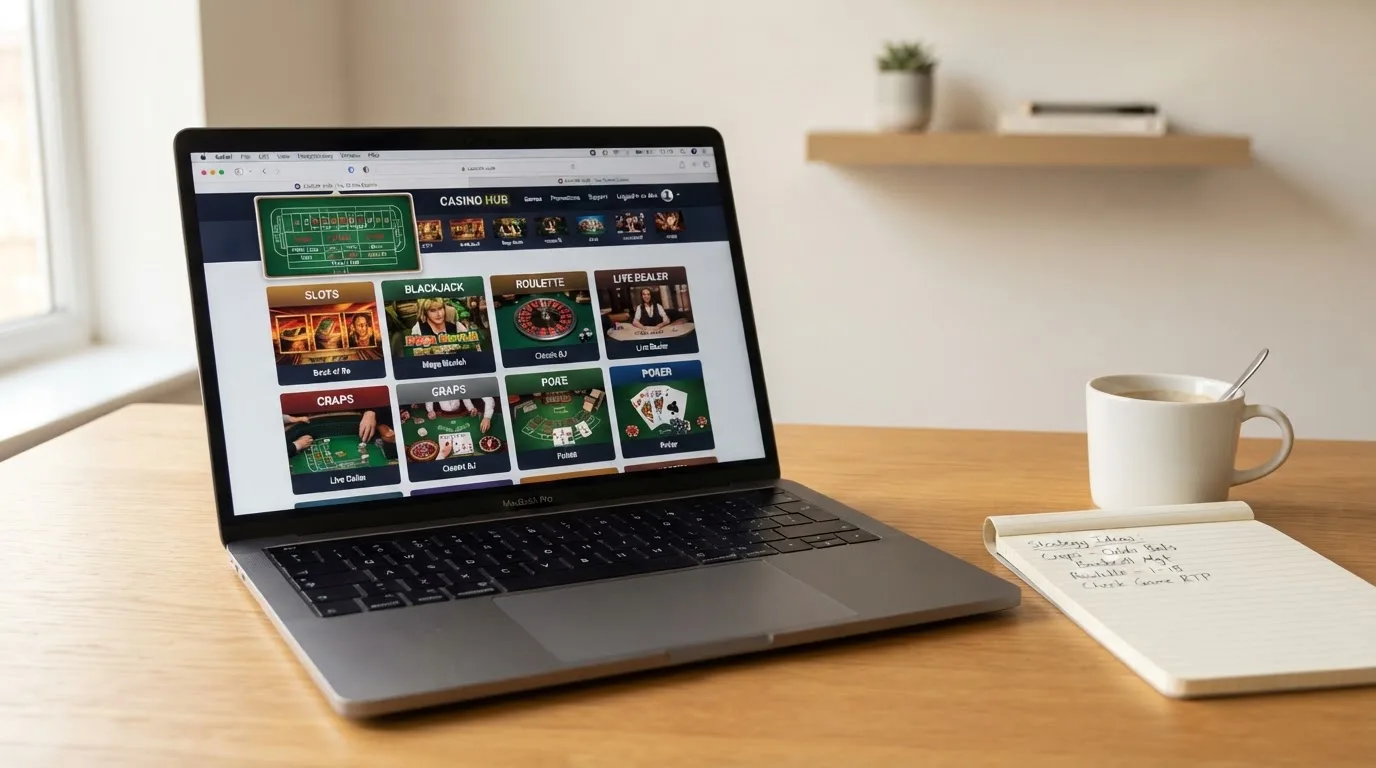
Live craps from Evolution runs inside the same HTML5 client that handles the studio’s roulette and blackjack, so the mobile experience matches whatever an operator already delivers for the rest of its live floor. A brand with a polished app for live roulette carries the same polish into live craps, and a brand that still pushes a downloadable casino client for its older games is the place to check that the browser version actually streams the dice game before the first deposit.
Mobile-specific deposit and verification prompts appear on every UK-licensed site. The identity check that runs before the first deposit completes inside the operator’s KYC flow regardless of whether the player is on the app or in a mobile browser, so there is no short cut to anonymous play through a phone. The “Play on mobile” landing page an operator advertises is the same product with the same terms attached.
The question that decides whether an app is worth the storage is the live lobby’s mobile footprint. Live craps streams at roughly the same bandwidth as the studio’s other table games, so any device that handles live roulette over Wi-Fi or 4G handles the dice. The comparison that matters is between the dedicated app’s offline lobby and the browser version’s search: the app usually opens to the live floor directly, while the browser version may need a category tap before the dice game appears.
The craps titles, providers and live tables UK players actually see
The craps library at a UK-licensed casino narrows to three buckets. First, RNG craps: a single-player digital table that runs without a dealer and resolves each roll through a certified random number generator. Second, live craps: a real dice table streamed from a studio with a live dealer and a built-in tutorial overlay. Third, hybrid releases: the rare title that pairs a dice layout with a side mechanic such as a crash curve, where the dice outcome still drives the main bet but a secondary multiplier rides alongside.

The European version of craps, sometimes called “craps” in the UK, plays on a flat layout with no Don’t Pass bar and uses different dice totals for the field bet than the American game. The version a UK player meets on a live table is the American layout, since that is what Evolution’s studio streams, and that is the layout this page describes unless stated otherwise.
Live craps from Evolution
Evolution’s Live Craps is the live dice game that appears in the lobbies of UK-licensed operators that carry the studio’s full live floor. The game runs in a speakeasy-themed studio with a built-in interactive tutorial and an “Easy Mode” aimed at players new to the game, both designed to teach the layout by walking a first-time player through Pass Line, Don’t Pass, Come, Field and the odds bet behind the line. The dealer manages the dice, announces the point and resolves each wager against the table’s paytable.
Each round splits into a Come Out roll and, when a point is set, a Point roll that runs until the point is made or the shooter sevens out. Some bets resolve after a single roll — the Field, Any Seven, the hardways after a single throw — and others, including Pass Line and the odds bet behind it, span several rolls. The tutorial overlay calls out which bets resolve on which roll, so a player new to the table can place a Pass Line bet and watch the round complete without reading the full paytable first.
The “Easy Mode” toggle reduces the visible bet set to a curated handful — Pass Line, Don’t Pass, Come, Field — and hides the prop bets and the hardways. A player who wants the full paytable can switch Easy Mode off and back into the standard layout at any time.
Aviator and the crash-game curve
Aviator is the crash-style multiplayer title that appears on some UK-licensed sites alongside the dice games and the slots, and the surface similarity to craps is the multiplier on the screen rather than the mechanic underneath. In a crash round, a curve rises from 1.00x and a player must cash out before the curve randomly crashes to win their stake multiplied by the value at cash-out. The game’s release year and operator footprint place it among the most widely distributed casino products online, and it is a separate game from craps despite both being labelled dice-adjacent in some marketing.
The craps table and the Aviator curve are not the same bet, and a player comparing the two is comparing two different games with two different edges. Craps carries a 1.41% house edge on the Pass Line and zero on the odds bet behind it. Aviator’s edge is the rake the operator takes from each round before the multiplier pays out. Neither bet is a substitute for the other, and the marketing line that pairs them rests on the dice imagery rather than the math.
The ten UK-licensed casinos compared side by side
The table below reads the Gambling Commission’s public register against the brands that come up most often in craps-related searches. Every operator listed holds an active remote casino operating licence and is on the register’s domain list as of the date this page was checked, which is what makes the brand eligible to take UK depositors in the first place. The subject support column is the page’s own gap: none of the ten carries a verifiable craps-specific licence note on the register, and the craps titles themselves sit behind the operator’s own lobby search.
| Brand | Licence holder and GB remote casino licence | Domain status on the register | Subject support |
|---|---|---|---|
| Grosvenor Casinos | Rank Interactive (Gibraltar) Limited · 057924-R-334666-005 | Active | — |
| Betfred | Petfre (Gibraltar) Limited · 039544-R-319290-010 | Active | — |
| 32Red | Platinum Gaming Limited · 045322-R-324275-019 | Active | — |
| BetVictor | BV Gaming Limited · 039576-R-319370-028 | Active | — |
| William Hill | WHG (International) Limited · 039225-R-319373-015 | Active | — |
| Virgin Games | Gamesys Operations Limited · 038905-R-319430-022 | White Label | — |
| Ladbrokes | LC International Limited · 054743-R-330863-014 | Active | — |
| Paddy Power | PPB Games Limited · 039411-R-319335-010 | Active | — |
| Betfair | PPB Games Limited · 039411-R-319335-010 | Active | — |
| Jackpotjoy | Gamesys Operations Limited · 038905-R-319430-022 | Active | — |
The licence number is the test. The number on the register has the form account-R-number-suffix, where the leading six digits repeat the licence holder’s account number and the R marks a remote licence. A player who wants to verify any brand above can paste that number into the Gambling Commission’s public register and confirm the operator, the licence status and the licence activities the holder is permitted to run.
The two licensee pairs on the list matter: Ladbrokes and Paddy Power both run under PPB Games Limited and its licence 039411-R-319335-010, while Virgin Games and Jackpotjoy both run under Gamesys Operations Limited and its licence 038905-R-319430-022. Reading the brands as independent operators from the licence numbers alone would be a misread of the register — they share the same licence and the same compliance obligations.
The white-label status attached to Virgin Games is the register’s way of saying the domain trades under another company’s licence rather than holding its own. The licence number still names the accountable party (Gamesys Operations Limited), so the player-facing protection is the same as for an active domain under the same licence. The difference shows up in the operator’s own terms, not on the register.
What a UK online casino is, and where craps fits inside it
A UK online casino is any operator that holds a Gambling Commission remote casino operating licence and lists at least one active domain against that licence on the Commission’s public register. The register is the test of legality — a Curaçao or Malta licence does not cover a brand taking UK depositors, and a brand that appears in a Google result without a UK licence is taking UK money without the section 33 protection the Gambling Act 2005 extends to players on the licensed side.
As of 18 September 2026 the register held 139 businesses with an active remote casino operating licence and 1,065 active domain entries alongside 361 white-label entries. The active domains are the brands the public meets; the 139 businesses are the legal persons behind them, often several brands to one licensee.
Craps is a niche table game by UK lobby standards, sitting behind the live studios’ roulette, blackjack and game-show titles. A player who searches the lobby at any of the ten operators above and finds no craps entry will not find one elsewhere on the same licence — the studio’s catalogue is the studio’s catalogue, and Evolution is the only major studio currently streaming live craps to UK-licensed sites. RNG craps titles appear more rarely, with the bulk of the live dice action concentrated in a small handful of supplier feeds.
A UK-licensed operator without live craps is not missing a game it should have — it is following the same product decision the rest of the UK market has made, which is to put the studio’s full live floor into the lobby and let craps sit inside it. A player who wants craps on the mobile browser needs an operator whose lobby surfaces Evolution’s live floor; a player who wants RNG craps needs an operator whose aggregator deal pulls in a dice title alongside the slots.
The UK licence that covers craps, and what it obliges an operator to do
The Gambling Commission, sponsored by DCMS, regulates commercial gambling in Great Britain under the Gambling Act 2005. The Act covers England, Scotland and Wales; Northern Ireland runs its own regime. Since the Gambling (Licensing and Advertising) Act 2014 any operator taking customers in Great Britain needs a Commission licence wherever it is based. A Gibraltar, Maltese or Curaçao licence is not a substitute, and a brand that takes a UK deposit on a foreign licence is on the wrong side of section 33 of the 2005 Act.
The Commission’s Licensing Conditions and Codes of Practice (LCCP) and its Remote Technical Standards bind every licensee to a set of obligations that shape the player experience. Identity verification runs before the first deposit and any play — name, address and date of birth, verified since 7 May 2019 — and the operator must prompt a customer to set a financial limit before the first deposit. From 31 October 2021 auto-play is banned, a slot spin may not be faster than 2.5 seconds and “losses disguised as wins” are banned. From 9 April 2025 a £5 maximum stake per game cycle applies to players aged 25 and over; from 21 May 2025 the same limit falls to £2 for 18-to-24-year-olds. None of these rules apply to craps — craps is a table game, not an online slot — but the operator’s compliance with them is part of the licence test, and the rules around stake limits, spin speed and auto-play tell a player how seriously the operator takes the safer-gambling design rules that govern its table games too.
A player who wants to verify any operator named on this page can search the Commission’s public register by the licence number, the account number or the domain. The register is downloadable as CSV or Excel, which is how the data above was pulled. The licence number on the register is the licence number that matters for the deposit protection that sits behind the brand.
Safer-gambling protection around craps at UK-licensed sites
Every UK-licensed online casino must enrol a player with GAMSTOP, the national online self-exclusion scheme, when the player requests it. GAMSTOP is a mandatory condition of every online licence since 31 March 2020, with self-exclusion periods of six months, one year or five years that cannot be cancelled early. A player who has registered with GAMSTOP cannot deposit, wager or access marketing at any UK-licensed operator for the duration of the period, and a licensed operator is required to check the GAMSTOP database before allowing play. The same protection extends to craps: a self-excluded player cannot sit at a live craps table on a UK-licensed site.
The financial vulnerability check at £150 net deposits in a rolling 30 days runs from 28 February 2025 using public data only. It is a friction point that appears at the same threshold regardless of which game the player wants to play, and a craps-only player crosses it on the same deposit trail as a slots player. The wider financial risk assessments have been announced but are not yet in force; when they land, they will cover craps deposits alongside every other deposit at the operator.
The deposit limit the operator must prompt a customer to set before the first deposit is a player-set number, not a state-set ceiling. The operator must offer the prompt; the player decides the number. The cap exists from 31 October 2025 and applies to every first-time depositor at the operator. A craps player who wants a hard cap has to set one, and the operator’s own limit tools sit inside the account page.
Help is at GamCare and the National Gambling Helpline, with GambleAware as the funded research and treatment body. None of these is a substitute for GAMSTOP, and a self-exclusion request goes through the operator or through GAMSTOP directly rather than through a helpline. The Commission publishes a list of approved alternative dispute resolution (ADR) providers for players who want to escalate a complaint against a licensed operator.
Crypto, low-friction payments and the licence test that applies to all of them
There is no UK-licensed route to anonymous play. The Commission’s verification rules require name, address and date of birth to be confirmed before the first deposit and any play, and that obligation extends to every payment method the operator accepts. A crypto deposit at a UK-licensed casino sits behind the same KYC flow as a debit card deposit, and the same identity checks run regardless of whether the player funds the account in pounds or in a coin. Credit cards have been banned for gambling since 14 April 2020, including credit cards routed through e-wallets, and the ban is independent of the player’s choice of currency.
The brands the search results often pair with “crypto craps” are Curaçao-licensed, not UK-licensed. A Curaçao licence does not cover a UK depositor, and a player depositing from a UK address on a Curaçao brand is outside the protection the Commission extends — no GAMSTOP, no Commission complaints route, no ADR. The marketing line that pairs “crypto” with “UK craps casino” rests on the payment method, not on the licence, and the licence is the part that determines whether the rest of the Commission’s safer-gambling rules apply.
A player who wants to deposit at a UK-licensed brand with a low-friction method can use a debit card, an open-banking transfer or any e-wallet the operator lists, subject to the operator’s own payment-method table. The friction is in the operator’s KYC flow rather than in the payment rail, and a UK-licensed operator with e-wallet deposits will run the same identity check on the e-wallet deposit as on a card deposit. The Commission’s job on the licensed side is to make sure the player has been verified; the payment method is the player’s choice.
Bonus terms for craps at UK-licensed casinos
The wagering requirement at a UK-licensed casino is capped at 10x since 19 December 2025. That cap applies to every bonus the operator offers, including any bonus labelled as available on table games, and a 10x wagering cap is a ceiling on what the operator may demand, not the floor a player should expect. The bonus terms tied to a craps-eligible offer vary by operator, but the ceiling sits across all of them.
A craps bonus at a UK-licensed site is usually a deposit match with a game weighting that reduces the contribution of craps to wagering relative to slots. Slots typically contribute 100% of each wager to the wagering requirement, while table games contribute a fraction of that — sometimes 10%, sometimes 20%, sometimes excluded entirely. A 100% deposit match bonus with a 10x wagering cap and 10% table-game weighting requires a player to wager a substantially larger amount on craps than the headline bonus figure suggests, because only one in ten pounds wagered counts toward the requirement. The combination is the term to read before the deposit.
Mixed-product bonuses, where a sportsbook bet unlocks a casino bonus, have been banned since 19 December 2025. The “bet £10 on football, get £20 of casino bonus” mechanic that lived in the UK market through 2024 is no longer available at any UK-licensed operator, and a craps-eligible bonus is a casino-only bonus, not a sportsbook plus casino construction. A player searching a craps bonus on a UK-licensed site will find casino-only offers.
The “no deposit” bonus that some offshore brands use to attract sign-ups is not a category the UK market leans on. The identity check that runs before any play at a UK-licensed operator makes a no-deposit bonus impractical, since the player must verify before the bonus is paid out, and the bonus terms on the licensed side usually require a deposit before the bonus funds become withdrawable. A craps-eligible bonus at a UK-licensed site is therefore a deposit-gated offer, not a free-play offer.
The 10x wagering cap, in practice
The 10x wagering cap means a £100 bonus requires £1,000 of wagering before the bonus funds become withdrawable. On a craps table with 10% game weighting, that £1,000 of effective wagering needs £10,000 of table play, and that £10,000 has to happen on a table that resolves each round quickly. Live craps rounds run at the dealer’s pace, with the come-out roll, the point roll and the resolution taking about a minute per round at the studio’s standard speed, while an RNG craps table resolves each roll in a few seconds and is the faster vehicle for clearing a bonus. The wagering cap is the ceiling on what the operator can demand; the speed at which the player can clear it is a function of the table format.
The bonus’s real cost is the expected loss over the wagering, which depends on the table’s house edge. Live craps carries a 1.41% edge on Pass Line and zero on the odds bet behind it, but the odds bet only exists behind a Pass Line bet, and the Pass Line bet is the bet that drives the wagering contribution. A player clearing a £100 bonus at a live craps table with 10% weighting and £10,000 of table play gives up £141 of expected loss to the house edge on the Pass Line alone, plus any additional expected loss on the proposition bets that don’t contribute to wagering. The cap is the rule; the math is the cost.
The face of craps at a UK online casino
The craps table a UK player meets online is the American layout. Two dice on a U-shaped table, with duplicate betting areas at each end so the shooter and the players around the table can reach their bets without leaning across the layout. The walls around the table are pyramid-textured, designed to randomise the dice throw so that the shooter cannot aim a controlled result. The online version preserves the layout but moves the dice to a transparent plastic cage inside the studio, with a dealer pressing a button to release them after the bets close.
The Pass Line bet sits on the near edge of the layout and wins on a come-out roll of 7 or 11, loses on 2, 3 or 12, and converts to a point bet on 4, 5, 6, 8, 9 or 10. The point number is marked with a marker puck, and the round continues until the point is made or the shooter sevens out. The Don’t Pass bet is the mirror image, winning on the come-out roll of 2 or 3 (with 12 a push, not a win), losing on 7 or 11, and converting to a point bet against the shooter. The Come and Don’t Come bets work the same way as Pass and Don’t Pass, but are placed after the point is set.
The odds bet sits behind the Pass Line or the Don’t Pass, pays at true mathematical odds and carries a 0% house edge. The odds bet can only be made alongside an existing Pass Line or Don’t Pass bet, which is the structural reason it exists as a separate wager rather than a stand-alone bet. A Pass Line bet with double odds behind it carries a blended edge of 0.61%, and that is the closest thing to a fair bet on the craps table.
The proposition bets in the centre of the layout — Any Seven, the hardways, the hop bets, Any Craps — carry house edges between roughly 5% and 16.7%, with the Any Seven at 16.9% being the highest edge on the table. These bets exist for the player who wants a quick resolution on a single roll, and they are the bets the tutorial overlay at Evolution’s live studio flags as the ones to avoid for bankroll longevity.
| Bet Type | House Edge |
|---|---|
| Pass Line | 1.41% |
| Don’t Pass | 1.36% |
| Place 6 or 8 | 1.52% |
| Place 5 or 9 | 4.00% |
| Place 4 or 10 | 6.67% |
| Any Seven | 16.9% |
The Place bet on 4, 5, 6, 8, 9 or 10 wins if the chosen number is rolled before 7, with the payouts varying by number: 9-to-5 on 4 and 10, 7-to-5 on 5 and 9, 7-to-6 on 6 and 8. The Place bet carries a house edge of 1.52% on 6 and 8, 4% on 5 and 9, and 6.67% on 4 and 10. The Buy bet, a Place bet with the true-odds payout less a 5% commission, carries a lower edge on 4 and 10 but only becomes worthwhile at a larger stake.
The Field bet wins on a roll of 2, 3, 4, 9, 10, 11 or 12, with 2 and 12 typically paying double or triple, and carries a house edge between 2.78% and 5.56% depending on the field’s payout table. The Field is a one-roll bet that resolves on every throw, which is the structural reason players lean on it during a choppy table, but the edge is higher than the Pass Line and the prop bets are higher again.
Mobile craps at a UK-licensed casino, in practice
The phone is the most common place to play craps online in the UK. Live craps streams to the mobile browser, with the table layout adapted to a portrait or landscape view depending on the operator’s app or website. The portrait view is functional for a Pass Line bet and a Field bet, but the centre proposition bets are easier to read in landscape, where the layout sits horizontally and the bets can be tapped without crowding the dice animation. A tablet opens the standard layout by default and is the closer reading experience to a physical table.
A dedicated casino app on iOS or Android holds the lobby in offline cache and opens to the live floor directly, which is the practical difference between an app and the browser. The live stream still depends on the network, so the cache buys only the lobby navigation; the dice still need a connection to land. An app is worth the storage for a player who switches between live craps and the operator’s other live tables, since the cache removes the lobby tap on every session.
The deposit and verification flow on mobile is the same flow as on desktop, with the operator’s KYC prompt appearing before the first deposit regardless of the device. The “Play on mobile” landing page is the same product with the same terms attached, and a craps player on a phone is subject to the same licence conditions as a craps player on a laptop.
A player who wants to test the mobile experience before depositing can usually open the live craps table in the operator’s free-play mode if one is offered, with a separate demo balance and no live betting. The free-play mode is the cleanest way to read the layout on the phone a player will actually use, and it is the last step before the first real-money deposit.
The reviewed operators, one by one
Grosvenor Casinos — the live-floor depth of a UK high-street name
Grosvenor Casinos operates under licence 057924-R-334666-005 (Rank Interactive). It brings high-street casino experience to the digital space, with a live floor mirroring its physical venues.
Safer-gambling measures follow LCCP rules. Grosvenor’s high-street pedigree defines its brand, though its UK licence status is the primary regulatory benchmark.
Betfred — the sportsbook-rooted lobby
Betfred operates under licence 039544-R-319290-010 (Petfre). Its lobby integrates sportsbook and casino, carrying the standard live-dealer suite. Craps here is almost exclusively live.
Safer-gambling measures follow LCCP rules, with mandatory deposit prompts and GAMSTOP. Betfred’s sportsbook history defines its product layout, but licence compliance remains the operative factor.
32Red — the live-heavy studio feed
32Red holds licence 045322-R-324275-019 (Platinum Gaming). Known for live-dealer emphasis, the site integrates Evolution’s feed, giving players full access to studio tutorial suites and table controls.
Compliance with LCCP guidelines is standard, covering all necessary safety tools. The operator’s live casino focus provides a clear gaming environment for craps enthusiasts.
BetVictor — the casino and sportsbook dual lobby
BetVictor operates under licence 039576-R-319370-028 (BV Gaming). Its platform separates sports and casino sections, both maintained to standard operator specifications. The craps experience is derived from the live-dealer feed.
Safer-gambling protocols align with LCCP mandates, including standard protection tools. The platform’s dual-lobby design is its defining feature, but verified licensure is the baseline requirement.
William Hill — the high-street chain with the full live floor
William Hill, under licence 039225-R-319373-015 (WHG), maintains an active presence. The platform features the standard studio live-dealer catalogue, ensuring craps is integrated within the broader Evolution feed.
The site adheres to LCCP safety conditions, including GAMSTOP. While the operator’s high-street presence is well-known, its compliance record is the relevant marker.
Virgin Games — the white-label Gamesys brand
Virgin Games operates as a white-label under licence 038905-R-319430-022 (Gamesys Operations). Because it trades under a third-party licence, Gamesys remains accountable for safer-gambling compliance. Craps availability mirrors the parent company’s live floor.
Safer-gambling obligations are fulfilled through the overarching Gamesys licence. The branding is secondary to the regulatory framework that governs operations.
Ladbrokes — the LC International licence
Ladbrokes uses licence 054743-R-330863-014 (LC International). It shares infrastructure with Coral and Gala Bingo, integrating the studio’s full live catalogue, including craps, into its lobby.
The operator maintains LCCP-standard safer-gambling measures, such as deposit prompts and GAMSTOP. Corporate classification under LC International sets the compliance scope; the register serves as the final authority on operational legality.
Paddy Power — the PPB Games licence
Paddy Power holds licence 039411-R-319335-010 (PPB Games) and is listed on the register. The platform features the standard studio live catalogue, providing craps access with the full suite of game tools, such as tutorials and Easy Mode.
Safer-gambling practices are consistent with LCCP guidelines. The PPB Games licence establishes the regulatory boundaries for Paddy Power; the register confirms the brand’s active status.
Betfair — the same PPB Games licence as Paddy Power
Betfair is listed on the Commission’s register as an active domain of account 39411, PPB Games Limited, which holds the active remote casino operating licence 039411-R-319335-010. The brand shares the licence with Paddy Power, and the two brands are different trading names under the same licensee. The casino lobby carries the same studio feed as Paddy Power, and the craps offering sits inside the same Evolution live craps game.
The operator’s safer-gambling pages run to the LCCP standard. The PPB Games licence is the corporate line the brand sits on; the licence number on the register is the part that does the work.
Jackpotjoy — the Gamesys licence alongside Virgin Games
Jackpotjoy is listed on the Commission’s register as an active domain of account 38905, Gamesys Operations Limited, which holds the active remote casino operating licence 038905-R-319430-022. The brand shares its licence with Virgin Games, and the two brands are different trading names under the same Gamesys Operations Limited licence. The casino lobby carries the same studio feed, and the craps offering follows the live floor Gamesys runs.
The operator’s safer-gambling pages run to the LCCP standard. The Gamesys Operations Limited licence is the corporate line the brand sits on; the licence number on the register is the part that does the work.
Craps in the broader UK online casino landscape
Craps is a niche in the UK online casino market, and the niche has not changed materially in the last several years. The live studios that stream craps to UK-licensed sites number one at the time of writing, with Evolution the supplier of the only major live craps feed. RNG craps titles appear more rarely and are usually supplied by studios that have signed separate aggregator deals.
The UK online casino landscape outside craps is dominated by slots, with roulette, blackjack, game shows and baccarat rounding out the typical lobby. The Commission’s slot stake limits (£5 for 25+, £2 for 18-24) apply to online slots and not to craps, but the operator’s compliance with the Commission’s safer-gambling design rules is the same for the craps table as for the slots lobby. A player reading the safer-gambling pages of any UK-licensed operator is reading the same LCCP framework that shapes the craps table’s session limits.
The market’s growth has been concentrated in slots and live game shows rather than table games, which is the structural reason craps has stayed a small part of the typical UK lobby. A player who wants craps as the primary reason to choose a casino is choosing among a handful of brands that carry the Evolution live feed, and the choice between them is the choice between licence-holder brands rather than between craps products.
The Commission’s own enforcement is on the licensed side of the market. The Commission disrupts illegal sites through cease-and-desist notices, search-engine delisting, payment and hosting referrals, but it has no ISP-blocking power, and the player-facing penalty for playing on an unlicensed site is the absence of the licensed side’s protection. The brands on this page are the licensed side; the search results that pair “crypto” with “UK craps” without naming a UK licence are the unlicensed side, and the two should not be confused.
Reading the craps paytable before the dice roll
The Pass Line carries a 1.41% house edge, which is the lowest edge on the table after the odds bet behind it. The Don’t Pass carries 1.36%, with the 12 push rather than a loss slightly improving the edge relative to the Pass Line. The Place bets on 6 and 8 carry 1.52%, on 5 and 9 carry 4%, and on 4 and 10 carry 6.67%. The Buy bet reduces the edge on 4 and 10 to roughly 4.76% after the 5% commission, with the breakeven stake around $20. The proposition bets in the centre of the layout range from roughly 5% to 16.9%, with Any Seven the highest edge on the table.
The odds bet behind the Pass Line pays at true mathematical odds and carries a 0% house edge. On a point of 4 or 10 the odds bet pays 2-to-1; on 5 or 9 it pays 3-to-2; on 6 or 8 it pays 6-to-5. The odds bet is the only bet on the table with no house edge, and the practical limit on its size is the operator’s own maximum, which is typically 3x, 5x or 10x the Pass Line bet depending on the table.
The Pass Line bet with double odds behind it carries a blended edge of 0.61%, and with 3x, 5x or 10x odds the blended edge falls to 0.47%, 0.33% and 0.18% respectively. The blended edge is what a player pays over the long run when the bet is split between the Pass Line and the odds behind it, and a player who wants the lowest possible edge plays Pass Line with maximum odds and avoids the centre proposition bets.
The craps table a UK player meets online is a casino game, not a stock-market bet, and the house edge is the price of the bet. The Pass Line is the cheapest bet on the table by a clear margin, the centre props are the most expensive, and the table’s edge distribution is one of the widest of any UK casino game. Reading the paytable is the cleanest single thing a player can do before the dice roll.
The maths that sits behind the bonus
A £100 bonus at a UK-licensed casino is now capped at £1,000 of wagering, with the 10x cap in force since 19 December 2025. The wagering requirement is a player obligation rather than a deposit return, and a player who clears it gives up the expected loss on the wagering volume. At a craps table with a 1.41% house edge on Pass Line and 10% game weighting, clearing a £100 bonus requires £10,000 of table play and gives up £141 of expected loss to the edge on the Pass Line, before any contribution from the centre proposition bets.
The bonus’s real cost sits above the wagering cap, in the expected loss over the volume of play the cap forces. A player who deposits £100 to clear a £100 bonus has, at the end of the wagering, expected to be £141 worse on the craps table alone, before any additional expected loss on the prop bets that don’t contribute to wagering. The bonus ends up cheaper than the equivalent play on a slots-only bonus with 100% weighting, because craps is a low-edge game relative to most online slots, and the expected loss on £10,000 of craps play is £141 versus several hundred pounds on a typical online slot.
The cap is the ceiling on the operator’s demand, not the floor on the player’s cost. The floor sits inside the table’s house edge multiplied by the volume the weighting forces, and the cost is the expected loss rather than the bonus size.
The craps table at the end of the page
The craps table at a UK-licensed online casino is a niche product in a market dominated by slots, and the choice between the brands on this page is the choice between licence holders rather than between craps products. The game’s paytable is the same wherever the player meets it, the licence number is the licence number that matters, and the bonus terms attached to a first deposit are the only place the craps player sees a number that varies between brands.
The 10x wagering cap that took effect on 19 December 2025 is the new shape of the UK craps bonus. A player who reads the cap, the game weighting and the table’s house edge before the deposit has read the only three numbers that matter; a player who reads the bonus size alone has not.
The Commission’s public register is the page’s reference and the player’s reference. Every brand above is named with the licence number on the register, and a player who wants to verify any of them can paste the number into the register and confirm the licence, the licensee and the domain status. The register is the test; the table above is the page’s read of it.
Frequently asked questions
How do craps payouts work at a licensed UK online casino?
A Pass Line bet pays 1-to-1 on a win, with the odds bet behind it paying at true mathematical odds on the point number — 2-to-1 on 4 or 10, 3-to-2 on 5 or 9, 6-to-5 on 6 or 8. Place bets pay at varying odds depending on the number, with the centre proposition bets paying higher amounts on a single roll but at a higher house edge. A Don’t Pass bet pays 1-to-1 on a win, with 12 a push rather than a win. Every payout is set by the table’s paytable and resolved at the end of the round.
Is online craps available as a live-dealer game or only as a digital table?
Both formats exist at UK-licensed casinos. Evolution’s live craps streams from a studio with a live dealer and a built-in tutorial overlay, and RNG craps runs as a single-player digital table. Live craps is the format most UK-licensed operators carry; RNG craps appears in a smaller number of lobbies.
Can craps be played through a casino app on a phone?
Yes. UK-licensed operators stream live craps to the mobile browser, and a dedicated casino app on iOS or Android opens the live floor directly. The dice stream depends on the network regardless of the device, and the app’s offline cache covers the lobby navigation rather than the live throw.
Do UK craps tables use the same bet types as a physical casino table?
The bet set is the same American layout — Pass Line, Don’t Pass, Come, Don’t Come, Field, Place bets, Buy bets, the odds bet behind the line, and the centre proposition bets. The online version preserves the layout but moves the dice to a transparent plastic cage inside the studio, with a dealer pressing a button to release them after the bets close.
What bonus terms usually apply when a bonus can be used on craps?
The wagering requirement is capped at 10x since 19 December 2025, and table games usually contribute a fraction of the slots weighting to the requirement — sometimes 10%, sometimes 20%, sometimes excluded. Mixed-product bonuses have been banned since the same date. A craps-eligible bonus at a UK-licensed casino is therefore a casino-only deposit offer with a wagering requirement that reads off the bonus amount times the cap.
Are craps tables offered by crypto-friendly casinos different from standard ones?
The craps paytable is the same regardless of the payment method, but the licence behind the table is not. A UK-licensed operator must verify a player’s identity before any first deposit regardless of the payment rail, and a crypto deposit at a UK-licensed casino sits behind the same KYC flow as a debit card. A Curaçao-licensed brand that markets itself as “crypto-friendly” is on a foreign licence and does not extend the Commission’s protection to UK depositors, so the difference is the licence rather than the craps table.
Published by the rtpslotsguide team.