What the UK casino sign-up bonus market actually looks like this year
The headline number most marketing puts forward — “up to £X” in bonus funds — is the smallest part of any sign-up offer a UK-licensed casino runs in 2026. The size sits on top of three structural rules that determine what the bonus is worth to the person who claims it: a 10x ceiling on wagering, a ban on credit-card funding, and a regulator that lists the operator’s licence on a public register anyone can search. Take those away and the headline is just a number; put them back and a £100 bonus becomes a quantified cost the player carries. That is what this page is for.
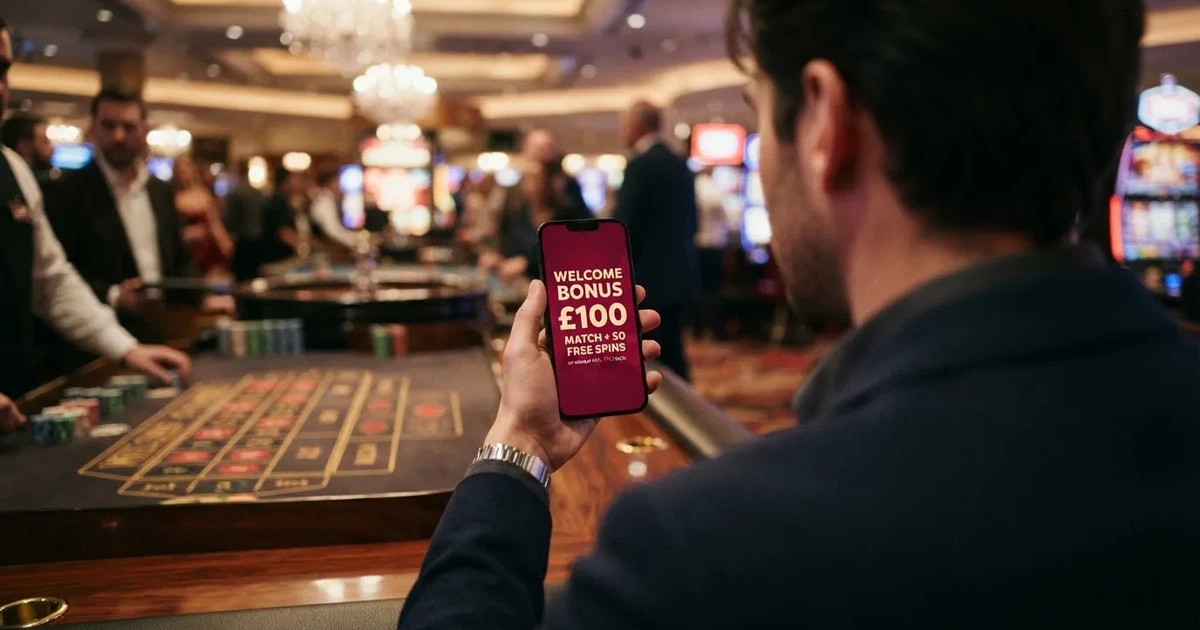
Current as of 8 November 2026, cross-checked against the Gambling Commission’s public register of gambling businesses.
Table of Contents
- Why a Gambling Commission licence is the only thing that matters
- Safer-gambling protections a player meets before the bonus kicks in
- How deposits and withdrawals actually move at a UK-licensed casino
- The sign-up bonus itself, under the 10x cap
- The top UK-licensed casinos with a sign-up bonus, ranked
- What the picture amounts to
- Frequently asked questions
Why a Gambling Commission licence is the only thing that matters
Every online casino that takes a deposit from a customer in Great Britain needs a Gambling Commission licence — that has been the case since the Gambling (Licensing and Advertising) Act 2014 came into force, and a Curaçao, Maltese or Gibraltar licence is not a substitute. The Commission is sponsored by the Department for Culture, Media and Sport and operates under the Gambling Act 2005, which covers England, Scotland and Wales but not Northern Ireland. The licence that lets a brand run an online casino remotely is called a remote casino operating licence, and it carries a number of the form account number-R-licence number-suffix — the leading six digits repeat the licence holder’s account number, and the “R” marks the licence as remote. The Commission maintains a public register at gamblingcommission.gov.uk that holds the licence for every operator and the list of websites that operate under it.

Two numbers from that register, as a snapshot of the market the rest of this page sits inside: on 18 September 2026 the register listed 139 businesses holding an active remote casino operating licence, and the domain list held 1,065 active entries and 361 white-label entries — a white-label site is one that trades under another company’s licence rather than holding its own. Every brand in the comparison table below appears on that register under its own account.
What holding a Commission licence actually obliges an operator to do is more concrete than the licence itself suggests. The Commission’s Licence Conditions and Codes of Practice (LCCP) sit alongside the Gambling Act and the Remote Technical Standards, and they cover four things a reader will meet before they play. First, identity: name, address and date of birth must be verified before a customer makes a first deposit or places a first bet — a rule in force since 7 May 2019, and the reason no GB-licensed site lets a player stay anonymous. Second, stake limits on online slots: from 9 April 2025 the maximum stake per game cycle is £5 for players aged 25 and over, and from 21 May 2025 it is £2 for players aged 18 to 24 — a per-spin ceiling, not a per-session one. Third, the operator must prompt every new customer to set a financial reality check before the first deposit, in force from 31 October 2025, and the customer may decline. Fourth, every online licensee must take part in GAMSTOP, the national self-exclusion scheme, which is the structural reason an excluded player cannot simply open a new account at a different licensed brand.
A remote casino licence is not a stamp of approval on the bonuses an operator runs. The Commission does not approve the headline figure, the number of free spins, or the small print that turns the headline into a real cost. What it does enforce is the structural rule that re-shaped every sign-up offer on the market: since 19 December 2025 wagering requirements are capped at 10x the bonus amount, and mixed-product bonuses — the old “bet on sport, get casino spins” trick — are banned. The 10x ceiling is the rule the rest of this page works against.
Safer-gambling protections a player meets before the bonus kicks in
The safer-gambling controls a GB-licensed casino must apply are not optional, and they sit between a player and the sign-up bonus regardless of which brand they pick. GAMSTOP is the first one: a player who has registered for self-exclusion with GAMSTOP cannot open a new account at any participating site for the chosen period — six months, one year or five years, with no early cancellation. The Gambling Commission made GAMSTOP participation mandatory for every online licence from 31 March 2020, and the same operator cannot quietly waive the check.

The second layer is the financial vulnerability check. Since 28 February 2025 a licensee must run a vulnerability check once a customer has deposited £150 net in a rolling 30 days; the check uses publicly available data only, and a wider financial risk assessment framework has been announced but is not yet in force. The check does not stop a player depositing; it triggers a conversation between the operator and the customer about whether the level of play matches the customer’s situation. The third layer is the deposit-limit prompt: since 31 October 2025 every customer must be asked to set a financial limit before their first deposit, with the option to decline. A customer who declines is recorded as having declined, and the operator has done its statutory duty.
Other structural protections matter more in practice than they sound: auto-play has been banned on slots since 31 October 2021, a slot spin cannot complete faster than 2.5 seconds, and losses disguised as wins — a slot animation that celebrates a net loss as if it were a payout — are banned. The minimum age is 18 across the board. The National Gambling Helpline runs through GamCare, and GambleAware funds treatment and research; neither is the operator’s own service, and that is the point.
What a licence does not do, and where the player is on their own: the Commission can fine or revoke a licence, and it can disrupt an unlicensed operator through cease-and-desist notices, search-engine delisting and payment-blocking referrals. It has no power to compel an internet service provider to block an offshore site, and it has no authority over an operator that has decided to ignore the licence regime. There is no penalty aimed at the player who plays at an unlicensed site, but the player loses every protection above — no GAMSTOP exclusion, no Commission complaints route, no approved alternative dispute resolution. That is what an unlicensed site costs, and it is not a marketing distinction.
How deposits and withdrawals actually move at a UK-licensed casino
The credit-card ban sits in the deposit flow, and most players meet it on the first try. Since 14 April 2020 the Gambling Commission has banned the use of credit cards to fund gambling across all online and offline gambling products in Great Britain, with the sole exception of non-remote lotteries paid for face-to-face. The ban catches credit cards routed through e-wallets, not just credit cards entered directly — paying a deposit with an e-wallet that has been topped up by credit card is also out. Debit cards and bank transfers are unaffected, and the bank-transfer rail inside the UK is the Faster Payments Service, launched in 2008 and operated by Pay.UK: 24-hour operation, most payments arriving instantly or within a couple of minutes, and a £1,000,000 per-transaction scheme limit that banks routinely tighten on individual customers.
The practical payment menu at a GB-licensed site therefore settles into three clusters. The first is debit cards and Faster Payments bank transfers, which are universal and unblocked. The second is e-wallets — Apple Pay, AstroPay and the rest of the field — and these work subject to the credit-card-funding rule, which means a customer cannot load the wallet from a credit card and then deposit from the wallet. Apple Pay uses tokenisation to protect card data: the real card number is replaced by a device-specific Device Primary Account Number, and each transaction carries a dynamic security code; in-store payments ride on near-field communication, but for an online casino the relevant fact is that the funding source must be a supported debit card from a participating issuer, not a credit card. AstroPay, founded in 2009 and headquartered in Uruguay, runs its UK entity as Larstal Limited, an electronic money institution authorised by the Financial Conduct Authority under the Electronic Money Regulations 2011 — a regulated route, but the credit-card-funding rule applies to it the same way. The third cluster is the small set of niche rails — prepaid vouchers, pay-by-mobile — that some brands still offer; the registration and source-of-funds checks that the operator runs catch a credit card regardless of which rail the customer tries.
What this means for the bonus: a sign-up offer that requires a “first deposit of £10 by debit card” is a routine condition; a sign-up offer that requires “deposit by any available method” still excludes credit-card-funded wallets under the Commission’s 2020 ban. Read the small print for the funding source, not just the minimum.
On the withdrawal side, the operator’s identity checks are the rate-limiter. A withdrawal request goes back through the same source-of-funds and identity-verification gates the deposit went through — name, address, date of birth, and the proof of where the deposited money came from. Most established brands turn a verified withdrawal around in hours via Faster Payments; a brand that has not seen a withdrawal request from this account before can take longer, and that delay is usually verification rather than payment.
The sign-up bonus itself, under the 10x cap
A sign-up bonus at a UK-licensed casino is no longer the offer it was before 19 December 2025. Before that date the typical headline sat alongside a wagering multiple of 35x or 65x, and the headline number told the reader almost nothing about what the bonus cost in time at the slots. The Commission capped wagering requirements on casino bonuses at 10x from 19 December 2025, and the same reform banned mixed-product bonuses — a customer can no longer be required to bet on a sportsbook to unlock a casino-spin reward, or vice versa. The rule is in the LCCP, not in marketing copy, and the Commission does enforce it.
The shape a sign-up bonus now takes is one of three. The first is a deposit match: the customer deposits, the operator matches a percentage of the deposit as bonus funds, and the bonus carries a wagering requirement of up to 10x the bonus amount. A £100 deposit at a 100% match with 10x wagering means the player must turn £1,000 over before bonus funds become withdrawable — and that is the ceiling, not the floor, since the cap is on the operator. The second shape is free spins awarded on registration or on first deposit: each spin is played at a fixed stake and the resulting winnings are bonus funds that carry the same 10x ceiling. The third shape is a no-deposit bonus — bonus funds or a small number of free spins awarded for completing registration and verification, with no deposit required; the 10x ceiling applies to these too, and they are typically smaller in headline value because no deposit is at stake.
The wording on these offers is what a sharp reader needs to read. A “100% match up to £100, 10x wagering” sounds fair and is fair under the new rule; the same headline in 2024 would have carried 35x and cost the player four times the time at the slots. “Free spins winnings paid as bonus funds, 10x wagering” is now the standard small print — older offers paid spin winnings as real money with no wagering, and the Commission’s 10x ceiling did not grandfather that arrangement, so any “winnings in cash, no wagering” line at a GB-licensed site is now a feature to be checked rather than taken for granted. “Max cashout” caps on no-deposit bonuses — the rule that caps withdrawable winnings from a bonus at a fixed figure, often £100 or £200 — sit outside the 10x cap and remain common; they are not banned, and they are the kind of term a player should read before claiming.
The credit-card ban also touches the bonus in a less obvious way. A sign-up offer that promises “extra spins when you deposit by Visa” is offering the same product as a debit-card deposit, since credit cards are out anyway; the more important version is “deposit by Apple Pay” or “deposit by AstroPay” — the operator is asking the player to use a specific rail, and the rail must accept debit-card funding. E-wallets that were topped up by credit card do not satisfy the rule, and the operator’s deposit-side check is the same check that catches a player who tries to circumvent the ban.
What 10x wagering actually costs in time
A worked example, using the cap and a representative offer. Take a £100 deposit matched at 100% as bonus funds: bonus amount £100, wagering requirement 10x, required turnover £1,000. At an online slot with a £1 stake per spin, that is 1,000 spins. The Remote Technical Standards set a minimum spin cycle of 2.5 seconds, so 1,000 spins at that floor is 2,500 seconds, or roughly 42 minutes of continuous play. Most players play slower than the floor, and a £0.50 stake doubles the spin count to 2,000 and the time at the floor to roughly 83 minutes. The 10x ceiling has compressed what used to be a four-hour clearance on a 65x bonus into something a player can clear in an evening.
The same arithmetic, framed as a band. For a £100 bonus with 10x wagering and a stake between £0.50 and £5 per spin, the player faces between 200 spins and 2,000 spins before the bonus clears — between roughly 14 minutes and 1 hour 23 minutes of slot time at the 2.5-second floor, with no break. The wider the stake range the player accepts, the wider the time band; the lower the stake, the longer the session. For a £50 bonus with 10x wagering, the band shrinks to 100 to 1,000 spins and 7 to 42 minutes at the floor. For a £200 bonus, the band is 400 to 4,000 spins and 28 minutes to 2 hours 46 minutes. The 10x ceiling has not removed the cost — it has put a firm upper bound on it.
These are statistical estimates. They describe the average number of spins the bonus requires at the stated stake and the minimum cycle time, not a guaranteed outcome for any single player. A session that runs slower than the 2.5-second floor takes proportionally longer; a session interrupted by reality checks takes longer still. The estimate assumes only the bonus amount is wagered, and does not count the player’s real-money bankroll, which sits alongside the bonus and is the more likely source of any payout.
A note on what the bonus does not cover. The Commission’s reform capped wagering and banned mixed-product offers, but it did not standardise the game contribution chart — the table that says a slot contributes 100% of each stake to wagering, while a blackjack hand contributes 10% or 0%. A reader who plans to clear the bonus on a table game needs to read the contribution chart in the offer terms, because the headline 10x can become a working 100x in practice. The reform also did not ban max-cashout caps, time limits on the bonus, or “irregular play” clauses that let the operator void the bonus for behaviour it considers abusive; these remain standard small print, and a £100 bonus that expires in 72 hours is not the same offer as a £100 bonus that expires in 30 days.
The top UK-licensed casinos with a sign-up bonus, ranked
The comparison below sets out ten brands that appear on the Gambling Commission’s public register as active or white-label domains under a remote casino operating licence. The ranking is the order the research set out, not a recommendation; the table carries the licence, the licence holder, the domain status on the register and the subject support for each brand, and the prose around it picks out what makes each entry worth a closer look or worth a pass. Every brand on the table takes part in GAMSTOP, so the safer-gambling controls above apply across the board.
| Brand | Licence holder and GB remote casino licence | Domain status | Subject support |
|---|---|---|---|
| Grosvenor Casinos | Rank Interactive (Gibraltar) Limited, 057924-R-334666-005 | Active | — |
| Betfred | Petfre (Gibraltar) Limited, 039544-R-319290-010 | Active | — |
| 32Red | Platinum Gaming Limited, 045322-R-324275-019 | Active | — |
| BetVictor | BV Gaming Limited, 039576-R-319370-028 | Active | — |
| William Hill | WHG (International) Limited, 039225-R-319373-015 | Active | — |
| Virgin Games | Gamesys Operations Limited, 038905-R-319430-022 | White Label | — |
| Ladbrokes | LC International Limited, 054743-R-330863-014 | Active | — |
| Paddy Power | PPB Games Limited, 039411-R-319335-010 | Active | — |
| Betfair | PPB Games Limited, 039411-R-319335-010 | Active | — |
| Jackpotjoy | Gamesys Operations Limited, 038905-R-319430-022 | Active | — |
A note on what the table does not carry. The Commission’s public register lists a brand, its licence holder and its domain — it does not carry the bonus terms a customer will see when they land on the homepage, and it does not rank brands by sign-up offer. The 10x wagering ceiling is the rule every brand above works under, and the differences between them are in the products and policies the register does not capture. Read the table for the licence picture and the prose below for the rest.
Grosvenor Casinos — a single licence for a multi-channel brand
Rank Interactive (Gibraltar) Limited runs Grosvenor Casinos on a single account — 57924 — and the licence on file, 057924-R-334666-005, is the licence that covers the online casino vertical alongside the live rooms that share the brand. The advantage of that arrangement is operational: the live-room business is the asset the online casino is layered onto, and a player who already has a Grosvenor card can move their play between channels under the same loyalty programme. The disadvantage is that an account-57924 brand is one operator’s product, and any safer-gambling or complaints decision the player makes is a decision with Rank Interactive.
Betfred — a long-running high-street name behind the screen
Betfred runs under Petfre (Gibraltar) Limited on account 39544, with the active remote casino licence 039544-R-319290-010. Petfre is a long-established Gibraltar company tied to the Fred Done group, and the licence history on the register shows a long string of suffix numbers, which is the Commission’s way of recording each renewal and significant variation. A player who values an operator that has been on the register since the early years of GB-remote regulation will find what they are looking for here; a player who values a younger, mobile-first product will look elsewhere.
32Red — a focused casino-only brand
Platinum Gaming Limited, account 45322, licence 045322-R-324275-019, is the operator behind 32Red. The licence is one of the more recent on the register by suffix count, and the brand has kept a casino-only focus rather than branching into sportsbook or bingo. For a reader whose interest is sign-up bonus at the slots specifically, that focus is the structural reason a casino-only operator tends to put its promotional budget into casino products rather than into cross-vertical offers — the Commission’s mixed-product ban from 19 December 2025 made that distinction meaningless at the offer level, but the budget split behind it remains.
BetVictor — an established operator with a long licence trail
BV Gaming Limited runs BetVictor on account 39576 under licence 039576-R-319370-028. The suffix trail on the licence is long, which is again the register’s way of recording the operator’s history under the same account. BetVictor sits on the register alongside its sibling brands under the same parent, and a reader who already has an account with one of them will see the same safer-gambling controls and the same GAMSTOP integration.
William Hill — the high-street brand the online casino sits inside
WHG (International) Limited, account 39225, licence 039225-R-319373-015. William Hill is the legacy high-street name, and the licence on file is the one that covers the online casino under the same brand. The arrangement is similar to Grosvenor’s in that a long-running land-based name sits behind an online licence, and the same caveat applies: the operator is the licence holder, and a single set of safer-gambling controls applies across the brand’s verticals.
Virgin Games — a white-label brand on a third-party licence
Virgin Games is the first entry on the table that is not an active domain under its own licence. The register lists Virgin Games as a white-label domain of account 38905, Gamesys Operations Limited, which holds licence 038905-R-319430-022. A white-label site trades under another company’s licence: the customer-facing brand is Virgin Games, the legal operator and the licence holder is Gamesys Operations, and any complaint the customer makes is a complaint against Gamesys. The distinction matters at the complaints stage and at the safer-gambling-controls stage, where the same controls apply but the party that runs them is Gamesys rather than a Virgin entity.
Ladbrokes — the Entain group under its historic name
Ladbrokes runs under LC International Limited, account 54743, licence 054743-R-330863-014. LC International is the Entain subsidiary that operates the Ladbrokes, Coral and Gala Bingo brands under the same remote casino licence, and a player who signs up with one of the three signs up with LC International for the purposes of safer-gambling controls, complaints and ADR. The licence account is younger than some on the table — the 54743 range reflects the Entain reorganisation — and the suffix trail on the licence is the live record of any renewal since.
Paddy Power and Betfair — a shared licence under PPB Games
Paddy Power and Betfair sit on the same line of the register by design: both are active domains of account 39411, PPB Games Limited, licence 039411-R-319335-010. The Flutter-owned PPB Games Limited is the operator behind both brands, and the licence on file covers both. A reader who treats Paddy Power and Betfair as separate operators is mistaken at the licence level — they are two products from one operator, and a complaint the customer makes with one is on the same operator’s books as a complaint the customer makes with the other. For sign-up bonus purposes that means two separate welcome offers under the same operator; for safer-gambling purposes it means GAMSTOP enrolment on one propagates to the other.
Jackpotjoy — the active sibling of Virgin Games
Jackpotjoy is the active-domain sibling of Virgin Games on the same licence: account 38905, Gamesys Operations Limited, 038905-R-319430-022. The difference from Virgin Games is the domain status — Jackpotjoy is listed as Active, not White Label — and the customer-facing product, which is a bingo-led site rather than a casino-led one. The licence picture is identical, and a reader comparing the two on the licence line of the table is comparing two products from one operator rather than two operators.
What the picture amounts to
The licensed set above is narrower than the headline suggests. Ten brands, but only seven distinct licence holders: Rank Interactive (Gibraltar) Limited, Petfre (Gibraltar) Limited, Platinum Gaming Limited, BV Gaming Limited, WHG (International) Limited, Gamesys Operations Limited, LC International Limited, and PPB Games Limited covers two of the ten by design. The Commission’s 139 active remote casino licences do not show up here as a long tail of competing operators — most of them run white-label sites that do not have a customer-facing brand of their own, and the consumer-facing market is concentrated in a smaller set of names. A reader who wants to compare “UK-licensed casinos” in the strict sense is comparing this set, plus a longer tail of white-label domains that are not in the table.
The 10x wagering cap has changed what a comparison actually settles. Under the old 35x and 65x offers, the comparison was about who made the bonus the cheapest to clear in absolute terms — a question whose answer depended on stake, game contribution and time. Under the 10x cap, the question is more about who offers a bonus the player can actually use: a £100 bonus at 10x wagering on slots is now a routine cost a player can plan around, while a £20 no-deposit bonus at 10x with a £100 max cashout is still a niche offer with a hard ceiling. The comparison has shifted from “who has the smallest multiple” to “who offers terms the player can read in full”.
A note on what the comparison does not settle. None of the brands above is recommended here as a place to play, and the licence picture is not a quality ranking. The Commission does not rank brands by sign-up bonus; it lists them, with their licence number, on a register anyone can read. The rest of the choice — what the bonus looks like, what the wagering terms are in full, what the game contribution chart says, what the max-cashout cap is, what the bonus expiry is — sits in the small print of each offer, and the small print is the part a reader has to read on the day.
A note on the offshore alternative, since the search behind this page will surface it. A site that holds only a Curaçao, Maltese or Gibraltar licence and is not on the Commission’s register may still accept UK customers in practice, and the Commission has the power to disrupt it — cease-and-desist, search-engine delisting, payment and hosting referrals — but no power to compel an ISP to block it. The player on an offshore site loses every protection the licensed set offers: no GAMSTOP, no Commission complaints route, no approved ADR, and no recourse under the LCCP. There is no player-side penalty, but the structural cost is the protection that is not there.
A note on tax, which is the one thing the licensed set does not change. UK players pay no tax on gambling winnings; operators pay Remote Gaming Duty, raised from 21% to 40% from 1 April 2026. The rate change affects what the operator has to make on each pound staked, not what the player keeps, and the headline offer is unaffected. A reader who hears that Remote Gaming Duty has gone up should expect operators to push harder on margin, not on the headline number.
Frequently asked questions
What counts as the best casino sign-up bonus in the UK right now?
A bonus that fits the player’s stake and time budget, with a wagering requirement at or under the 10x ceiling the Commission has enforced since 19 December 2025. A £100 bonus at 10x wagering on slots is now the standard shape; the choice is in the small print — game contribution, max-cashout cap, expiry — not in the headline.
Does a UK casino need a Gambling Commission licence to offer a sign-up bonus?
Yes. The Gambling (Licensing and Advertising) Act 2014 requires any operator taking customers in Great Britain to hold a Commission licence, and a Curaçao, Maltese or Gibraltar licence is not a substitute. The Commission’s public register at gamblingcommission.gov.uk lists every active licence holder and the domains under it.
Is a no-deposit sign-up bonus different from a deposit-match sign-up bonus?
Yes. A no-deposit bonus is awarded on registration and verification, before any deposit, and is typically smaller; a deposit match is a percentage of the customer’s first deposit as bonus funds. Both carry the 10x wagering ceiling, and no-deposit offers commonly retain a max-cashout cap that deposit offers usually do not.
How much wagering applies to a typical sign-up bonus under the UK’s current cap?
Up to 10x the bonus amount. The 10x ceiling took effect on 19 December 2025 and applies to casino bonuses at GB-licensed sites; mixed-product offers such as “bet on sport, get casino spins” were banned at the same time. A £100 bonus therefore requires £1,000 of qualifying turnover before the bonus funds become withdrawable.
Does a sign-up bonus expire if it is left unused?
Yes, typically within 7 to 30 days of being credited. The expiry is set in the offer’s small print and is not standardised by the Commission’s 10x cap, so a player who plans to come back to the bonus needs to read the expiry on the offer they are claiming. An unused bonus is usually forfeit at expiry, along with any winnings tied to it.
Can a sign-up bonus be claimed more than once on the same account?
No. The welcome offer is one per customer, per operator, and is tied to the identity verified under the Commission’s 7 May 2019 rule — name, address and date of birth. A player with multiple accounts at the same operator will see the second account treated as a duplicate and the welcome offer refused, and that refusal is the Commission’s rule rather than the operator’s discretion.