Birthday bonuses at British casinos: how the licence shapes the offer
Data current as of 8 November 2026 and verified against the Gambling Commission’s public register of gambling businesses.
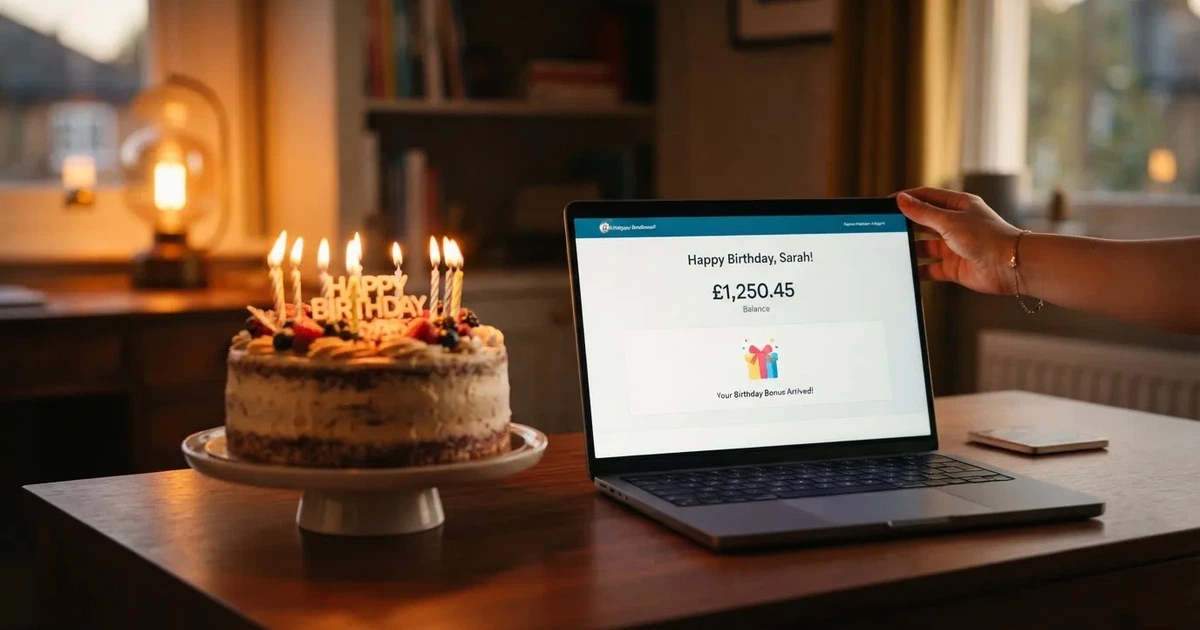
A birthday bonus at a British casino is, on paper, the same kind of incentive as any other promotional credit: a small amount of bonus money, a handful of free spins, or both, dropped into a player’s account once a year on the date the operator has on file. In practice it is one of the more lightly advertised perks on a licensed site, and one of the most narrowly framed by the rule book the operator is sitting under. The 10x wagering cap that took effect on 19 December 2025, the age-verification check that runs before a first deposit, and the GAMSTOP cross-check that every British-licensed operator runs against the national self-exclusion register all touch the birthday offer in exactly the way they touch a welcome bonus. None of these rules carve out a birthday-shaped exemption. That single fact — that there is no birthday-shaped exemption — is the one to carry through this page.
What follows goes through the rule frame first, because the rule frame is what makes a birthday bonus legible at all. It then walks through the responsible-gambling controls that apply on the day the bonus lands, the payments layer that determines whether the offer is genuinely “no deposit” or quietly deposit-gated, and the bonus mechanics themselves, including the wagering band the 10x cap produces under realistic stake assumptions. A short ranking of ten licensed British operators closes the substantive part, before an overview that returns to the fundamentals and a FAQ that handles the questions this material keeps producing.
Table of Contents
- Jurisdiction: why a birthday bonus only exists where the Commission licence runs
- Responsible gaming: what controls attach to the day the bonus lands
- Payments: where the birthday bonus sits inside the deposits question
- Bonus mechanics: the 10x cap and what it does to a birthday offer
- Ten licensed British casinos and how they sit on the birthday offer
- Fundamentals: what a birthday bonus actually is, and where it sits in the wider British promotional landscape
- Frequently asked questions
Jurisdiction: why a birthday bonus only exists where the Commission licence runs
A casino that takes customers in Great Britain needs a Gambling Commission licence to do so, and that licence has to be a remote (online) operating licence rather than a land-based one. The Commission has been explicit since the Gambling (Licensing and Advertising) Act 2014 that the location of the operator’s headquarters is no longer the test; a Gibraltar-, Malta- or Curaçao-registered company is welcome to apply, but it has to apply, and it has to hold the Commission licence before it accepts a single pound from a customer in England, Scotland or Wales. Northern Ireland is covered by separate legislation and is not part of this framework.

The public register is the whole test of whether a brand holds that licence. The Commission publishes a CSV and Excel download listing every operating licence account and every domain the Commission has associated with it, and the file is the authoritative answer to the question “is this site licensed?”. The register also gives away how the licence is structured: the licence number itself takes the form account-R-number-suffix, where the leading six digits repeat the operator’s account number and the “R” marks a remote licence. So 039372-R-319367-029 belongs to account 39372 (Betway Limited), and 061549-R-336718-002 belongs to account 61549 (Recro Limited). Knowing how to read that string is the difference between taking a brand’s own footer at face value and being able to verify it against the register in under a minute.
The register’s current shape, as it stood on 18 September 2026, was 139 active businesses holding an active remote casino operating licence, with 1065 active and 361 white-label domain entries attached to those businesses. A white-label entry is a domain that trades under another company’s licence — Virgin Games, for instance, runs under Gamesys Operations Limited’s licence as a white-label site rather than as a separately licensed brand. Several brands can sit under one licence account: Ladbrokes, Coral and Gala Bingo all share LC International Limited as their licensee, and Betfair and Paddy Power share PPB Games Limited. That sharing is invisible from the brand’s homepage, and the register is the only place where the relationship is laid out cleanly.
The consequence is that any birthday bonus on offer in Great Britain is, by definition, attached to one of these 139 licensed businesses, because providing gambling to people in Great Britain without a Commission licence is an offence under section 33 of the Gambling Act 2005. The Commission does pursue unlicensed sites — cease-and-desist notices, search-engine delisting, payment and hosting referrals — but it has no power to block at the ISP level, so an unlicensed brand is reachable from a British IP address until it is disrupted. The Commission’s stated position is that the player is not the target of enforcement; what the player loses on an unlicensed site is protection, not legal standing. No GAMSTOP. No ADR route. No complaints line into the Commission. A birthday bonus, like any other promotion, lives or dies on which side of that line the brand sits.
For the player comparing options, the practical takeaway is that the licence register is not a courtesy check — it is the only check that means anything. A footer line saying “licensed and regulated by the Gambling Commission” is something every licensed brand has, and is something a non-licensed brand has been known to print anyway. The register is the only place where the licence number, the licensee and the domain are tied together by the regulator that issued them.
Responsible gaming: what controls attach to the day the bonus lands
A birthday bonus is paid out by a licensed operator, so it inherits every responsible-gambling control the operator is required to run on every other transaction the player makes. There is no “lighter” version of the controls that applies once a year. The three that bite most visibly on a birthday offer are age and identity verification, GAMSTOP, and the deposit-limit prompt that has been mandatory since 31 October 2025.
Age and identity verification runs before the first deposit and before any play. The Commission tightened the verification regime on 7 May 2019, and the practical effect is that name, address and date of birth are checked before a pound moves. That matters for a birthday bonus specifically because the bonus is keyed to the date of birth on the verified account — if that date cannot be verified at sign-up, there is no birthday date to attach the bonus to, and the offer will either not appear or will not be paid when it should have been. Players who registered with one date of birth and later produced documents showing another have been known to lose the bonus entirely, because the operator’s system cannot reconcile a verified identity with two competing dates.
GAMSTOP, the national online self-exclusion scheme, became a mandatory condition of every online operating licence on 31 March 2020. A player who has registered with GAMSTOP for six months, one year or five years cannot be served by any British-licensed online operator for the duration of that period, and the registration cannot be cancelled early. The birthday bonus check is the same check the operator runs at every session: if GAMSTOP returns a match, the session ends and the bonus is not credited. This is the single most common reason a licensed site refuses to honour a promotion it has advertised, and it is the reason a self-excluded player should not be looking for ways around the exclusion.
The deposit-limit prompt that took effect on 31 October 2025 requires operators to ask a customer to set a financial limit before the first deposit. The prompt is not optional, and an operator cannot skip it on the grounds that the customer’s first action will be a no-deposit bonus rather than a deposit. The limit the player sets is the limit the operator applies — to deposits, not to bonus credits — but it sets the financial ceiling for the session in which the bonus arrives. The Commission has not introduced a state-set deposit or loss ceiling; the figure is the player’s own. There is, however, a separate control aimed at the financial picture rather than the deposit limit: a financial vulnerability check that runs at £150 of net deposits in a rolling 30-day window using public data only, in force since 28 February 2025. The wider, more intrusive financial risk assessments the Commission has signalled are not yet in force as of the register snapshot.
A separate layer sits over the slot itself rather than over the player’s account. Since 31 October 2021, auto-play is banned on online slots and a single spin may not complete faster than 2.5 seconds; “losses disguised as wins” — a slot celebration that fires on a spin that returned less than the stake — are also banned. The stake limit per game cycle is £5 for players aged 25 and over from 9 April 2025, and £2 for players aged 18-24 from 21 May 2025. None of these is a bonus rule, but every one of them constrains how the birthday bonus is actually played through: a player turning 25 the week the bonus lands will see the stake limit step up from £2 to £5, and that change matters for the wagering arithmetic the section on bonus mechanics works through.
The other point worth holding onto is that the responsible-gambling controls are a Commission condition, not a brand-level choice. A licensed operator that did not run GAMSTOP, did not verify identity at sign-up, or did not offer self-exclusion tools would be in breach of its licence. The brand cannot opt out of any of this in order to make its birthday bonus more generous. Where brands do differ is in the support offered on top of the baseline: National Gambling Helpline (GamCare) and GambleAware are signposted by every licensed site; a deposit-limit reminder schedule, a reality-check interval and a time-out configuration are operator-set within Commission bounds. GamCare’s number is 0808 8020 133.
Payments: where the birthday bonus sits inside the deposits question
The “no deposit” framing that shows up in much of the search traffic around this topic deserves careful handling, because the phrase means two different things. A genuinely no-deposit birthday bonus is one the operator credits to a verified account without the player having to make a payment first; the bonus is real money-equivalent or free spins, and the player can play it without ever having deposited. A deposit-gated birthday bonus is one that requires the player to have deposited within some prior window — often the previous 30 or 90 days — before the bonus is paid; a player who has not deposited will not see it.
The Commission’s framework does not force the operator to choose one shape or the other. It does, however, force several decisions around what happens to the winnings from either shape. A licensed site still verifies identity before releasing any withdrawal, so a no-deposit bonus that produces a real-money win still has to clear the same KYC queue as a deposit-derived win. The credit card ban that took effect on 14 April 2020 — across all online and offline gambling in Great Britain, with the narrow exception of non-remote lotteries paid for face-to-face — has no direct bearing on a no-deposit bonus, but it is the reason every deposit the player does make goes through a debit card, a bank transfer, or an e-wallet rather than a credit card. The Commission’s estimate at the time of the ban was that around 800,000 UK consumers had used credit cards to gamble in 2018, and that 22% of online gamblers who used credit cards to gamble were classed as problem gamblers.
For deposits themselves, the British payments rails are well-defined. Most UK bank transfers move through the Faster Payments Service, launched in 2008 and operated by Pay.UK, which runs 24 hours a day and processes most payments instantly or within a couple of minutes — the scheme itself says transfers can occasionally take up to two hours. The per-transaction limit for the scheme is £1,000,000, although a customer’s own bank may impose a lower limit, and the Bank of England is not a direct participant in Faster Payments but oversees the system’s safety and stability and provides final settlement. None of this is specific to a birthday bonus, but it is the rail a deposit-gated bonus is gated through, and the rail a withdrawal is paid out on when the bonus has cleared.
A secondary layer worth holding in mind is the e-wallet, several of which are well-established on British casino sites.
| Payment Method | Key Feature | Availability |
|---|---|---|
| Bank Transfer | Faster Payments (Pay.UK) | Instant |
| Apple Pay | Tokenised security | Widely used |
| AstroPay | Digital wallet / cards | Operator-dependent |
Apple Pay, which Apple Inc. develops and operates and launched on 20 October 2014 with US-issued cards, began supporting UK-issued payment cards on 14 July 2015. Apple Pay protects card data through tokenisation — replacing the actual card number with a device-specific tokenised Device Primary Account Number — and generates a dynamic security code for each transaction. The Apple Pay in-store payment flow uses near-field communication; on an iPhone with Face ID, an in-store purchase is authenticated by double-clicking the side button, on Touch ID models by double-clicking the Home button. Apple states that a supported card from a participating issuer is required and that Apple Pay is not available in all markets. None of this matters for a no-deposit bonus specifically; it matters for the deposit-gated version, because it is one of the rails a player may choose to fund the deposit that triggers the bonus.
AstroPay sits on a different part of the rail map. Founded in 2009 and headquartered in Uruguay, it operates as a global digital wallet offering online payments, virtual and physical debit cards, and peer-to-peer transfers. Its UK entity, Larstal Limited, is an electronic money institution authorised by the Financial Conduct Authority under the Electronic Money Regulations 2011, and its Isle of Man entity, AstroPay Global (IOM) Limited, is licensed by the Isle of Man Financial Services Authority for money transmission. AstroPay spun off its payment-processing business, dLocal, as a separate company in 2016, and now serves users across markets including Argentina, Australia, Brazil, Canada, Colombia, Denmark, Spain, the United Kingdom, the United States and Uruguay. Whether any given licensed British casino accepts AstroPay for a birthday-bonus-gating deposit is operator-by-operator — the register gives the licence, not the cashier’s payment-method list.
The payments picture that matters for the actual birthday offer is narrower than the full rail map. A no-deposit birthday bonus asks nothing of the rail because nothing moves through it; a deposit-gated one asks only that the player has made a deposit in the gating window, and the rail the deposit moved through is incidental. The thing that bites is the identity-verification queue that runs on the way out, regardless of how the bonus was paid in.
Bonus mechanics: the 10x cap and what it does to a birthday offer
The single rule that shapes every birthday bonus on a British-licensed site is the wagering requirement cap that took effect on 19 December 2025. From that date, wagering requirements on bonuses are capped at 10x the bonus amount, and mixed-product bonuses — a bet on sport that unlocks casino spins, for instance — are banned. A birthday bonus that took 50x turnover to clear two years ago would now have to be restructured to fit under 10x, and any operator still advertising a higher multiple would be in breach of the rule.
The arithmetic of the cap, working through a realistic birthday bonus, is what gives the rule its weight. Suppose an operator credits a £5 birthday bonus in bonus money, and the bonus carries the maximum-permitted 10x wagering requirement. The required turnover is £5 × 10 = £50. At a typical slot stake of £1 per spin, that turnover translates to 50 spins. At the Commission’s minimum spin length of 2.5 seconds, 50 spins take 125 seconds, or just over two minutes of button-pushing if every spin is taken manually and at maximum speed. The session does not stretch into hours; the wagering is essentially a formality.
Take a larger bonus to see where the cap starts to bite. Suppose an operator credits a £50 birthday bonus — a more generous offer, but still well within what the rule allows. The required turnover is £50 × 10 = £500. At a £1 stake, that is 500 spins. At 2.5 seconds per spin, the session runs 1250 seconds, or roughly 21 minutes of play. Still short, and well within the kind of session most players run for entertainment rather than as a job.
Stretch it further. A £100 bonus at 10x wagering produces £1,000 of turnover, 1,000 spins at £1 per spin, and approximately 42 minutes of slot play at the Commission’s 2.5-second minimum. A £200 bonus produces £2,000 of turnover, 2,000 spins, and approximately 83 minutes of play. These are not exhausting sessions by any standard — they are the kind of session a player might run on an evening without feeling the time — but they are no longer the trivial formality the £5 case was.
What shifts the picture is the stake. The Commission’s per-spin stake limits — £5 for players aged 25 and over, £2 for players aged 18-24 — mean that the time-to-clear calculation depends on age. A player aged 25 or over with a £200 bonus at 10x wagering can play at £5 per spin, in which case the same £2,000 of turnover is 400 spins, or approximately 17 minutes. A player aged 18-24 with the same bonus is held to £2 per spin, so the same £2,000 is 1,000 spins, or roughly 42 minutes. The cap is the same on both sides of the age threshold; the time-to-clear is not.
The wagering arithmetic is best stated as a band rather than a single number, because three inputs move at once: the bonus amount, the wagering multiple (capped at 10x), and the stake the player chooses to clear it at. Holding the cap and the stake fixed, the time-to-clear scales linearly with the bonus. Holding the cap and the bonus fixed, the time-to-clear scales inversely with the stake. The single figure the page can defend in plain prose is the rule itself: wagering requirements are capped at 10x, and that cap produces a manageable rather than punishing clearance time across the realistic bonus range.
Where the picture changes is on the win-cap. A licensed British casino is permitted to impose a maximum-cashout figure on a no-deposit bonus, and a birthday bonus that lands as a no-deposit offer often carries one. The cap is operator-set and is not a Commission rule — but the Commission’s general prohibition on unfair terms, and the LCCP condition that bonus terms be presented clearly, mean the cap has to be visible before the player opts in. A player who clears a £5 no-deposit bonus for £80 of real-money win and then discovers a £25 maximum-cashout clause has had the terms misrepresented; a player who reads the terms before opting in has had the cap applied as advertised.
The other structural element worth holding onto is the disqualification list. Most licensed operators carry a list of slot titles — usually a small handful, often branded as “restricted games” — on which bonus wagering either does not contribute at all, or contributes at a reduced rate. A 100% contribution is the norm; a 0% contribution is not. The list is operator-specific and is part of the bonus terms the player is asked to accept. Reading the terms before opting in is the only way to know whether the slots the player actually wants to play are eligible.
The picture the cap paints is this: a birthday bonus on a British-licensed site, taken at face value, is a small annual credit with a manageable clearance time and a transparent set of conditions. The 10x cap is what stops the offer from drifting into the territory the welcome bonus used to occupy, where a £100 credit could demand £4,000 of turnover at 40x. The cap is the rule that makes “birthday bonus” a category the player can take at face value.
Ten licensed British casinos and how they sit on the birthday offer
A ranking of casinos on the basis of their birthday bonus is hard to defend if the underlying offers are not in the public domain. Most British-licensed operators do not publish their birthday bonus in the main promotional banner; the offer is keyed to the player’s verified account and is communicated by email or in-account message on the relevant day. The ranking below is therefore not a ranking by bonus generosity — that comparison cannot be made from public data — but a ranking by the underlying licence, with the subject-support column showing what the register can and cannot say about the birthday bonus specifically. Where the register says nothing, the table says nothing.
| Brand | Licence holder | Domain Status | Support |
|---|---|---|---|
| Grosvenor Casinos | Rank Interactive (Gibraltar) Limited | Active | Yes |
| Virgin Games | Gamesys Operations Limited | White Label | Yes |
| Betway | Betway Limited | Active | Yes |
| PokerStars | Stars Interactive Limited | Active | Yes |
| Betfair | PPB Games Limited | Active | Yes |
| Paddy Power | PPB Games Limited | Active | Yes |
| 32Red | Platinum Gaming Limited | Active | Yes |
| Betfred | Petfre (Gibraltar) Limited | Active | Yes |
| Casumo | Recro Limited | Active | Yes |
| bet365 | Hillside (UK Gaming) ENC | Active | Yes |
Two things stand out from the register alone. First, Betfair and Paddy Power share a licence account — both are listed against PPB Games Limited’s 039411-R-319335-010. The two brands are run by the same licensee, on the same licence, and the birthday promotion a player sees on one is likely to be drawn from the same operator-side campaign the other runs. Second, Virgin Games runs as a white-label site under Gamesys Operations Limited; the licence is Gamesys’s, not a Virgin-owned entity, and any promotion a Virgin Games player sees has been set by Gamesys rather than by a Virgin-specific team. None of this is a judgement on the offer; it is the register speaking about the structure of the market.
Grosvenor Casinos — the land-based operator with an online licence
Grosvenor Casinos runs its online site under the remote casino operating licence 057924-R-334666-005 held by Rank Interactive (Gibraltar) Limited on account 57924. The brand sits on the register as an active domain, and the parent group, Rank, runs a chain of land-based casinos across the UK alongside the online arm. The dual presence matters because it shapes how the brand communicates promotions — the in-venue and online marketing are often coordinated, and a player who uses both may see offers the online-only player does not. Verified accounts receive birthday communications via their registered inbox.
Virgin Games — the white-label under Gamesys
Virgin Games is a white-label domain of account 38905, Gamesys Operations Limited, holder of licence 038905-R-319430-022. The “white-label” tag on the register is the structural point: the brand trades under Gamesys’s licence, and Gamesys is the entity the Commission regulates. The implication for a player is that any dispute about the bonus — a missing credit, a term that was unclear at opt-in — runs through Gamesys’s complaints process rather than through a Virgin-specific one, even though the brand on the homepage is Virgin’s. Birthday promotions are handled internally by the licensee and credited directly to eligible accounts.
Betway — the multi-product operator
Betway runs Betway under licence 039372-R-319367-029, held by Betway Limited on account 39372. The brand is one of the better-known multi-product operators in the UK — sportsbook, casino and esports all sit under the same licence account — and the breadth of the product line means the birthday offer is positioned within a wider promotional schedule that runs year-round. The Commission’s register is the licence record; it does not list the in-account promotions the player sees on the day. A player whose account is in good standing and whose date of birth is verified is the player who sees the offer; a player whose account is restricted or whose KYC is incomplete is not.
PokerStars — the poker-first brand under Stars Interactive
PokerStars runs PokerStars under licence 039108-R-319334-026, held by Stars Interactive Limited on account 39108. The brand’s roots are in poker rather than in casino products, but the UK site carries a casino tab as well as the poker client, and the birthday offer covers whichever product the player has used most in the gating window. The licence is Stars Interactive’s; the domain is the .uk variant specifically, not the global site, which is a distinction the Commission makes because the .uk domain is the one that takes customers in Great Britain under the Stars Interactive licence. Promotional incentives are credited directly to active, verified accounts.
Betfair — the betting-exchange parent that also runs a casino
Betfair runs Betfair under licence 039411-R-319335-010, held by PPB Games Limited on account 39411. The brand is best known as a betting exchange, but the casino product sits on the same licence and the same account, and the birthday offer a casino player sees is set by the same licensee that runs the exchange. The shared licence with Paddy Power is the structural point that matters here: the two brands run on one licence account, and the promotional infrastructure behind them is shared. Eligible players receive birthday-related incentives through their account notifications.
Paddy Power — the same licence, the same promotional plumbing
Paddy Power runs Paddy Power under the same licence as Betfair — 039411-R-319335-010, held by PPB Games Limited on account 39411. The two domains are both listed on the register as active. The promotional calendar is run by PPB Games; the customer-facing brand is Paddy Power’s. A birthday offer seen on Paddy Power is an offer set by the same licensee that sets Betfair’s, and any difference between the two brands is brand-level positioning rather than licence-level. Rewards are tailored to account status.
32Red — the casino-focused brand under Platinum Gaming
32Red runs 32red under licence 045322-R-324275-019, held by Platinum Gaming Limited on account 45322. The brand has positioned itself as a casino-first operation rather than a multi-product one, and the promotional schedule reflects that — the calendar is set around casino activity rather than sportsbook activity. The licence is Platinum Gaming’s; the brand is 32Red’s. Eligibility for birthday perks is determined by internal account activity.
Betfred — the high-street bookmaker with an online casino
Betfred runs Betfred under licence 039544-R-319290-010, held by Petfre (Gibraltar) Limited on account 39544. The brand’s roots are on the high street as a bookmaker, but the online arm carries a casino product alongside the sportsbook, and the promotional schedule runs across both. The .com domain is the one that takes customers in Great Britain under Petfre’s licence. Qualifying customers are notified privately on their birthday.
Casumo — the newer-licensee brand on the register
Casumo runs Casumo under licence 061549-R-336718-002, held by Recro Limited on account 61549. The account number — 61549 — is higher than most of the others on the list, which puts Casumo among the more recently licensed operators on the register, although “recent” here means a more recent licence account rather than a recent arrival in the market. Promotions are issued directly to verified users.
bet365 — the largest single brand on the register
bet365 runs bet365 under licence 055149-R-331499-004, held by Hillside (UK Gaming) ENC on account 55149. The brand is the largest single UK-facing casino and betting operator by customer volume, and the promotional schedule is run by Hillside (UK Gaming) ENC. A birthday offer on bet365 is set on the same licence account as the rest of the brand’s calendar, with offers sent directly to verified accounts.
The conclusion that holds across all ten is one the licence register does not make on its own: the birthday bonus exists on a British-licensed site, it sits under the same 10x wagering cap as any other promotion, and the register is the only public place where the licence behind the offer is recorded. The generosity ranking a player might want to do has to be done on the player’s own verified account, because none of the offers is published at the brand level.
Fundamentals: what a birthday bonus actually is, and where it sits in the wider British promotional landscape
A birthday bonus is an annual promotional credit a licensed casino pays to a verified player on the date of birth the operator has on file. The credit usually takes the form of bonus money, free spins, or a combination of the two, and the value is operator-set — there is no industry-wide minimum or maximum. What makes a birthday bonus distinctive is not the credit itself but the timing: it lands once a year, on a specific date, and the date is the verified date of birth on the player’s account. That timing is the reason the offer is keyed to identity verification; without a verified date, there is no date to key it to.

The wider promotional landscape the birthday bonus sits inside has been reshaped by two rule changes that took effect within the past five years. The first is the credit card ban of 14 April 2020, which closed off a deposit rail that had been associated with a disproportionate share of problem gambling — the Commission’s own estimate at the time was that 22% of online gamblers who used credit cards to gamble were classed as problem gamblers, and around 800,000 UK consumers had used credit cards to gamble in 2018. The second is the wagering cap of 19 December 2025, which closed off the territory where a small bonus could demand a large multiple of turnover. The two rules together have pulled the British promotional landscape away from the high-turnover welcome offers that defined the early 2020s and toward smaller, more transparent credits that the player can clear in a sitting.
The birthday bonus is, in this landscape, the smallest of the categories. The welcome bonus, where it still exists, is larger; the reload bonus is paid on deposits rather than on a calendar date; the cashback offer is paid on losses rather than on a date. The birthday offer is paid once a year, and the amount is modest by design — the 10x wagering cap means a larger credit would produce a heavier clearance, and the operator-side incentive to keep the offer small is the same as the Commission-side incentive to keep bonus terms transparent. A player who reads the offer as a free credit is reading it correctly; a player who reads it as a path to a large win is reading past the cap.
The minimum age to be eligible is 18, and the Commission has run age-verification at sign-up since 7 May 2019 — so by the time a player is in a position to receive a birthday bonus, the verification has already happened. The minimum age is also the trigger for the lower of the two stake tiers: a player aged 18-24 is held to £2 per spin, and a player aged 25 and over to £5. The age boundary sits in the middle of the typical player’s birthday-bonus career, which means a player who registers at 22 and turns 25 partway through will see the stake limit step up — and the time-to-clear on the same bonus will shorten — without anything else changing.
The wider context is that the British online casino market sits under one of the more interventionist regulatory regimes in Europe. The Remote Gaming Duty that operators pay was raised from 21% to 40% from 1 April 2026, which is the operator-side tax story and has no direct effect on a player’s winnings — UK players pay no tax on gambling winnings, only on certain professional-gambler or trading-income cases that do not apply here. The player-facing rule book is set by the Commission, and the Commission’s stated priorities on player protection are visible in the rule calendar: faster verification, lower stake limits on slots, mandatory GAMSTOP, the deposit-limit prompt and the wagering cap. A birthday bonus is, in this context, one of the more lightly advertised perks on a heavily regulated site.
What the fundamentals reduce to is a working definition the rest of the page can build on. A birthday bonus at a British casino is a once-a-year promotional credit paid to a verified player, sitting under the same 10x wagering cap and the same responsible-gambling controls as any other offer, and verifiable only against the licence that sits behind it. The credit is small, the clearance is short, and the offer does not appear on the register because the register is not a promotional calendar.
Frequently asked questions
What is a birthday bonus at an online casino, and how does a player qualify?
A birthday bonus is a once-a-year promotional credit — bonus money, free spins, or a combination — that a casino pays to a player on the date of birth the operator has on file. To qualify, the player’s account must have a verified date of birth on it, which means the player has cleared the operator’s KYC check at sign-up. The offer is communicated in-account or by email in the relevant week and is not advertised on the brand’s main promotional pages.
Does a birthday bonus at a UK casino require a deposit to claim?
It depends on the operator. A no-deposit birthday bonus credits the offer without requiring a payment, and a deposit-gated one requires the player to have deposited within some prior window — often the previous 30 or 90 days. The Commission’s rules do not force one shape or the other; the operator decides. A player whose account is in good standing and has a verified date of birth is the player who sees the offer, regardless of which shape the operator runs.
What wagering requirement applies to a typical birthday bonus in Britain?
Since 19 December 2025, wagering requirements on bonuses at British-licensed casinos are capped at 10x the bonus amount. A £5 bonus at the cap produces £50 of required turnover; a £50 bonus produces £500; a £200 bonus produces £2,000. Mixed-product bonuses are banned under the same rule, so a birthday bonus cannot be paid out in combination with a sportsbook free bet.
Which licensed British casinos are known for offering a birthday bonus?
The Commission’s register lists 139 active businesses holding a remote casino operating licence, with 1,065 active and 361 white-label domain entries against them. Every British-licensed casino is eligible to offer a birthday bonus under the same rule book, but the offer itself is not published on the register and is communicated to verified accounts only. The brands with active domains on the register include Grosvenor Casinos, Betway, PokerStars, Betfair, Paddy Power, 32Red, Betfred, Casumo and bet365; Virgin Games runs as a white-label site under Gamesys Operations Limited.
Does a player need to verify their date of birth before claiming a birthday bonus?
Yes. The Commission tightened verification on 7 May 2019, and name, address and date of birth are checked before the first deposit and before any play. Without a verified date of birth, the operator has nothing to key the bonus to, and the offer will not appear or will not be paid on the date the player expected. A player whose verified date of birth changes after sign-up should expect the bonus to follow the verified record rather than the original entry.
Is a birthday bonus treated any differently from other promotions under UK gambling rules?
No. The 10x wagering cap, the GAMSTOP cross-check, the deposit-limit prompt, the age-verification check, the £5 or £2 per-spin stake limit, the 2.5-second minimum spin length and the credit card deposit ban all apply to a birthday bonus in the same way they apply to a welcome bonus or a reload. There is no birthday-shaped exemption from any of these rules. The single thing that distinguishes a birthday offer is the timing — once a year, on a verified date — and not the rule frame around it.