Choosing a High-Cashback Casino in the UK for 2026
A reader who searched this page is not browsing. They want a side-by-side look at the UK-licensed casinos running the most generous cashback offers right now, what the offer actually costs them after the 10x wagering cap, and which operator fits the way they actually play. The Gambling Commission’s public register, the £5 / £2 slot stake ceiling, and the credit-card ban are not background colour — they shape every offer on the page below. This shortlist ranks ten brands by the cashback structure that suits a particular reader, from a high daily percentage for an active slots player to a modest weekly rebate for someone who only opens the site on a Saturday.

Last checked 8 November 2026 against the Gambling Commission’s public register of gambling businesses.
Table of Contents
- The Ten Brands at a Glance
- Why Cashback Looks Different From a Deposit Bonus
- The Regulatory Floor Under Every Offer on This Page
- What a Cashback Offer Costs in Real Turnover
- Safer-Gambling Controls Around a Cashback Offer
- Crypto Cashback and the Identity Check That Still Runs
- Payments, Payout Speed and the Cashback Side
- How the Cashback Offer Itself Is Structured
- Reading the Shortlist by Reader Type
- What the Cashback Offer Does Not Cover
- Tax, Payouts and the Operator’s Own Bill
- What to Confirm Before Depositing
- Ten Brands, Five Reader Types, One Register
- Frequently Asked Questions
The Ten Brands at a Glance
The table below sets out the regulatory shape of every brand on this page, because the offer only matters once the licence is settled. A brand without a remote casino operating licence cannot legally serve Great Britain, whatever its cashback looks like on a landing page. A white-label entry trades under another company’s licence and is not, despite the marketing language, an independent operator. The “subject support” column flags whether the research pass surfaced a Gambling Commission confirmation that this brand actively runs a cashback incentive in the form described on its pages; an em dash means no such statement is on the record and the offer should be checked directly with the operator before any deposit.
| Brand | Licence holder and GB remote casino licence | Domain status on the register | Subject support |
|---|---|---|---|
| Virgin Games | Gamesys Operations Limited, 038905-R-319430-022 | White-label domain | — |
| Betfred | Petfre (Gibraltar) Limited, 039544-R-319290-010 | Active | — |
| Betfair | PPB Games Limited, 039411-R-319335-010 | Active | — |
| Sky Vegas | Bonne Terre Gaming Limited, 065519-R-339675-002 | Active | — |
| Gala Bingo | LC International Limited, 054743-R-330863-014 | Active | — |
| 32Red | Platinum Gaming Limited, 045322-R-324275-019 | Active | — |
| Casumo | Recro Limited, 061549-R-336718-002 | Active | — |
| Midnite | Dribble Media Limited, 042647-R-321653-022 | Active | — |
| PokerStars | Stars Interactive Limited, 039108-R-319334-026 | Active | — |
| Jackpotjoy | Gamesys Operations Limited, 038905-R-319430-022 | Active | — |
Two licence holders sit behind three of the brands above: LC International runs Gala Bingo from the same remote licence, and Gamesys Operations runs both Virgin Games and Jackpotjoy under one account. A reader comparing offers across those three names is comparing three brands at one operator, not three independent operators — the cashback terms will sometimes drift, the underlying licence and safer-gambling controls will not.
Why Cashback Looks Different From a Deposit Bonus
A cashback offer returns a slice of net losses over a defined window — usually a day or a week — and the percentage is what the marketing copy leads with. A 20% weekly cashback sounds generous next to a 100% deposit match, but the two incentives do not behave the same way. A deposit match inflates the bankroll on day one and then asks for it back, plus a multiplier, before any withdrawal. Cashback runs the other direction: it pays out after the session, against losses that have already happened, and in many cases it returns as withdrawable cash rather than bonus funds.

That distinction is the one the wagering cap reshaped on 19 December 2025. Where a deposit bonus used to demand 35x or 40x the bonus amount before withdrawal, no UK-licensed casino can now impose more than 10x. Cashback has always sat closer to the affordable end of the bonus spectrum, often carrying no wagering at all, and the cap does not change that fact — but it tightens the gap. A reader who treated cashback as a low-priority sweetener is now justified in taking it seriously as a primary offer.
The terms that govern a cashback offer matter more than the headline percentage. Three clauses decide what the offer is really worth:
- The window. Daily cashback resets every 24 hours; weekly cashback resets on a fixed day. Daily offers suit a slots player who logs in once a day, weekly offers suit someone who plays in heavier but less frequent sessions.
- The cap. Some offers cap the cashback amount at a fixed figure (£50, £100, more), others cap it as a percentage of deposits. A 20% cashback with a £20 cap pays the same as a 10% cashback with no cap, once the losses clear the threshold.
- The wagering. Many UK cashback offers return cash; some return bonus funds subject to wagering. The 10x cap applies where wagering exists. Cash is preferable to bonus funds on the same percentage, because the cap can still bite if a reader treats the cashback as a bankroll reload rather than a partial recovery of losses.
The Regulatory Floor Under Every Offer on This Page
Every brand on the table above holds a remote casino operating licence from the Gambling Commission, and that licence carries obligations the cashback offer cannot undo. The Commission has run the register of gambling businesses as a public, downloadable CSV for years; on 18 September 2026 it held 139 businesses with an active remote casino licence and 1,065 active website entries, plus 361 white-label entries trading under another company’s account. A remote casino licence number follows a fixed pattern — six-digit account, the letter R for remote, a sequence number, and a suffix — and a reader can check any brand on this page against the register before depositing.
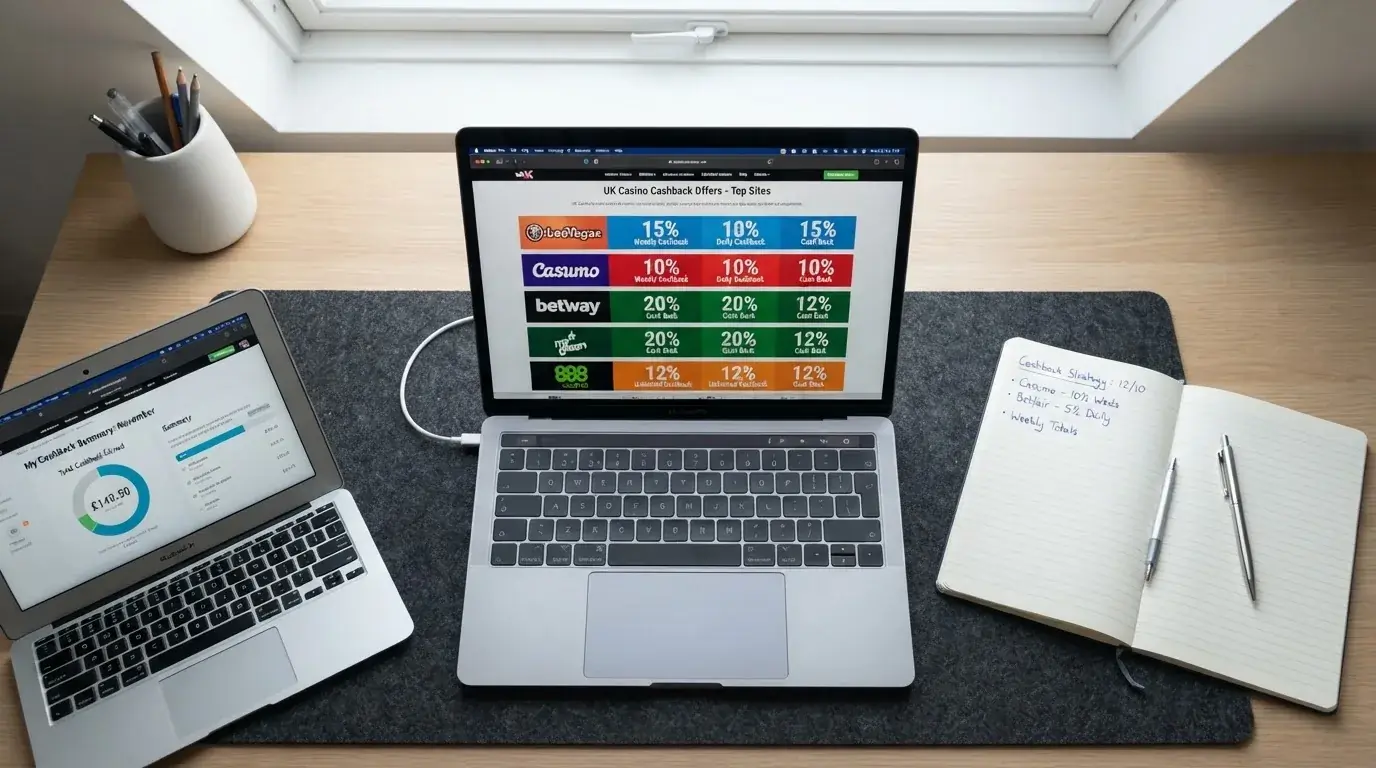
The framework is the Gambling Act 2005, supplemented by the Gambling (Licensing and Advertising) Act 2014, which brought every operator serving Great Britain into the Commission’s reach regardless of where the company is incorporated. A Curaçao, Maltese or Gibraltar corporate base is not a substitute; the test is whether the Commission has issued a licence and recorded the domain against it. Offshore brands that take UK customers without one commit an offence under section 33 of the Act; the consequence for the player is the absence of the Commission’s complaints route, GAMSTOP and any approved alternative dispute resolution, not a fine.
Three Commission rules govern the offer mechanics themselves. The credit-card ban, in force since 14 April 2020, applies to credit cards routed through e-wallets as well as direct card deposits — debit cards and bank transfers are unaffected. The wagering cap at 10x, in force since 19 December 2025, applies to every casino bonus a UK licensee offers, and it bans mixed-product bundles that hand out casino spins in return for a sports bet. The slot stake limits — £5 per spin for players 25 and over, £2 per spin for players 18 to 24 — apply per game cycle rather than per session, and they sit alongside the ban on auto-play and on losses disguised as wins. The 10x wagering cap on a £50 weekly cashback rebate is £500 of turnover before withdrawal, on the same bonus.
What a Cashback Offer Costs in Real Turnover
The 10x cap does not mean every offer is cheap to clear. The clearing cost depends on two figures: the cashback amount and the wagering multiple the operator attaches. Where an offer returns cash with no wagering, the cost is zero on top of the loss that triggered it. Where the offer returns bonus funds at 10x, the cost is the bonus multiplied by 10 — and the time to clear it depends on the stake per spin.
A worked example. Suppose a reader clears a £50 weekly cashback at 10x wagering, with the maximum slot stake permitted under their age band. For a player 25 and over, the stake is £5 per game cycle; for a player 18 to 24, the stake is £2 per cycle. The required turnover is £500 in both cases. At £5 per spin, £500 buys 100 spins; at the regulated minimum spin interval of 2.5 seconds, that is roughly 4 minutes and 10 seconds of play. At £2 per spin, the same £500 turnover takes 250 spins and roughly 10 minutes and 25 seconds. The clearing time is not the bottleneck; the offer’s real cost is the expected loss on the turnover itself, which depends on the slot’s return-to-player. A 96% RTP slot, played through £500 of turnover, returns £480 on average — a £20 expected loss to clear a £50 cashback that, on its face, looks like a 20% return on losses.
The point is not the arithmetic. The point is that the 10x cap made the clearing time trivial, but the underlying turnover still costs whatever the house edge on the chosen slot extracts from it. A reader chasing cashback through low-RTP titles can spend more clearing the bonus than the bonus is worth, and the offer’s appeal collapses once that comparison is on the page.
The table below bands the clearing cost for a few common cashback sizes at the 10x cap, with both stake tiers and the spin time at the regulated 2.5-second minimum. The bands span the two stake limits and assume the offer returns bonus funds rather than cash; the reader should treat any cashback without wagering as falling outside this band entirely.
| Cashback amount | Wagering turnover | Spins at £5 | Spins at £2 | Spin time (2.5s) |
|---|---|---|---|---|
| £20 | £200 | 40 | 100 | 100s – 250s |
| £50 | £500 | 100 | 250 | ~4m 10s – ~10m 25s |
| £100 | £1,000 | 200 | 500 | ~8m 20s – ~20m 50s |
| £200 | £2,000 | 400 | 1,000 | ~16m 40s – ~41m 40s |
The bands are tight at the bottom and widen only because the stake limit does. A 25-and-over player clears a £100 cashback rebate in roughly eight minutes of regulated spin time; an 18-to-24 player clears the same offer in roughly twenty minutes. Neither figure is the cost — both are the time. The cost is the expected loss on the turnover, which sits in the single-digit to low-double-digit pounds on most UK slots and is not in the band at all.
Safer-Gambling Controls Around a Cashback Offer
Cashback sits closer to the safer end of the bonus spectrum because it returns losses rather than front-loading them, but it can still undermine the protection a player has set up. A cashback rebate can mask the loss that triggered it, soften the sting of a bad session, and tempt the reader into another session to chase the next one. The safer-gambling controls on this page are not the offer’s marketing copy — they are the controls the Gambling Commission obliges every licensed operator to run, and a reader comparing offers should weigh them at the same time as the percentage.
The national self-exclusion register is GAMSTOP, mandatory on every GB-licensed online operator since 31 March 2020. Self-exclusion runs for six months, one year or five years, and cannot be cancelled early. A reader who has self-excluded through GAMSTOP is locked out of every brand on this page; no operator can override the exclusion, and any brand that allowed play would lose its licence.
The Commission’s financial vulnerability checks run at £150 of net deposits in a rolling 30 days, in force since 28 February 2025, using publicly available data. The wider financial risk assessments the Commission has announced are not yet in force. From 31 October 2025 every operator must prompt a customer to set a financial limit before the first deposit; the prompt is not a hard ceiling, it is a moment of friction. The reality-check pop-up at one hour of continuous play, the time-out facility, and the National Gambling Helpline run by GamCare sit alongside the prompts as the operator’s social responsibility code in practice.
Three practical points sit over the controls. First, cashback does not exempt a reader from GAMSTOP; an excluded account cannot earn cashback, claim it, or have it restored. Second, a deposit limit set before the first deposit applies to deposits that would otherwise earn cashback — the cap is upstream of the offer. Third, an offer that returns bonus funds rather than cash can confuse the picture for a player trying to track net deposits against the vulnerability-check threshold; the £150 is on deposits, not on bonuses, but a session funded partly by bonus funds can blur the line.
Crypto Cashback and the Identity Check That Still Runs
A reader searching for crypto casino cashback is looking for one of two things: a casino account funded in cryptocurrency, or a casino account that minimises the friction around identity verification. The two are not the same thing, and the second one is not available at a UK-licensed casino at all.
Every GB-licensed casino must verify the customer’s name, address and date of birth before the first deposit or any play, a rule in force since 7 May 2019. The verification does not pause for the funding method. A reader depositing in Bitcoin or another cryptocurrency goes through the same check as a reader depositing by debit card, and the funds arrive in the same pounds sterling balance once the operator has converted them. The cashback offer on a crypto-funded account behaves the same way as on a debit-card-funded account: weekly or daily, paid in pounds, subject to the same wagering rules where wagering exists.
What the offer looks like is a different question. Some UK-licensed operators restrict deposit methods for promotional eligibility — a deposit by Skrill or Neteller, for example, sometimes opts out of a welcome bonus. A cashback offer that pays on net losses regardless of funding method is the easier offer to compare, because the funding decision does not change the rebate. A reader who wants to deposit in crypto specifically should check the operator’s terms before the first deposit; some operators do not accept crypto at all, others accept a narrow set of coins, and the cashback eligibility can sit in a separate clause from the deposit eligibility.
The credit-card ban reaches further than the card itself. Since 14 April 2020 a credit card routed through an e-wallet is also banned; the ban does not catch cryptocurrency because cryptocurrency is not a credit instrument, but the underlying funding of a crypto purchase on credit would still fall foul of the spirit of the rule. The Commission’s rule is on funding the gambling account, not on funding the wallet that funds the account, so a debit card purchase of Bitcoin at a regulated exchange, followed by a Bitcoin deposit at a licensed casino, is in principle allowed.
Payments, Payout Speed and the Cashback Side
Cashback is paid out, not earned through wagering in the usual sense, so the payment side of the operator matters more for cashback than it does for a deposit match. A cashback offer that pays within hours is worth more than the same percentage that pays three days later, because the lost session has already happened and the recovery needs to be in the account before the next one starts. The payments themselves run through three rails at a UK-licensed casino, and the reader’s choice of rail is partly the operator’s.
Debit cards and bank transfers are the default. Within the UK, a bank transfer typically moves through the Faster Payments Service, launched in 2008 and operated by Pay.UK, which runs 24 hours a day and arrives within minutes for most payments; the scheme sets a £1,000,000 per-transaction ceiling, though individual banks set lower customer limits. The Bank of England oversees the scheme’s safety and provides final settlement, but is not a direct participant.
Apple Pay works at any operator that accepts it as a deposit rail. The service launched on 20 October 2014 in the United States and began supporting UK-issued cards on 14 July 2015; it tokenises card data, replacing the actual card number with a device-specific number and a dynamic security code for each transaction, and authenticates an in-store purchase with a double-click of the side button on Face ID models. Apple Pay is not a credit instrument, so the credit-card ban does not touch it; it sits alongside a debit card and behaves like one for deposit purposes. Where the operator marks Apple Pay deposits as ineligible for a promotional offer, that is the operator’s choice, not a rule.
E-wallets sit in the middle. AstroPay, founded in 2009 and headquartered in Uruguay, operates as a global digital wallet with electronic-money authorisation across multiple jurisdictions — its UK entity is FCA-authorised under the Electronic Money Regulations 2011, its Isle of Man entity is licensed by the Isle of Man Financial Services Authority, its Danish entity by the Danish FSA, and its Brazilian entity by the Brazilian Central Bank. AstroPay serves users across Argentina, Australia, Brazil, Canada, Colombia, Denmark, Spain, the UK, the US and Uruguay, and spun off its payment-processing business dLocal as a separate company in 2016. E-wallet deposits are usually the fastest in and the fastest out, and the credit-card ban reaches them when the underlying funding is a credit card. Skrill and Neteller are common at UK-licensed casinos but are often excluded from welcome bonuses — the cashback offer is rarely excluded by the same clause, because cashback runs on net losses rather than on the deposit that triggered it.
The Faster Payments instant arrival is the rail the cashback side leans on. A cashback rebate paid by bank transfer to a UK bank typically arrives in minutes; a cashback rebate paid by debit card usually takes one to three working days to clear the card network, and an e-wallet payout arrives inside the wallet almost immediately but takes an additional step to reach the bank.
How the Cashback Offer Itself Is Structured
The shape of a cashback offer varies more across the ten brands above than the marketing language suggests. A reader comparing offers should look past the percentage and read the small print for four things: the calculation base, the window, the cap, and the form of the payout.
The calculation base is what the percentage applies to. Net losses is the usual base — deposits minus withdrawals over the window — and it is the base that gives the reader the cleanest mental model. Some offers apply to “losing bets” only, excluding bonus play, which lowers the base and therefore the rebate; some apply to “stake” rather than to net loss, which inflates the base and the rebate but loses the symmetry a reader expects. The base the operator uses is the first thing to confirm.
The window determines when the offer resets. Daily cashback resets at a fixed time every day, often midnight UK time; weekly cashback resets on a fixed weekday. The window sits at the heart of the offer because the calculation base is over the window. A reader who plays in two short sessions a week gets a different cashback outcome under a daily offer than under a weekly offer, even at the same percentage, because the daily offer’s lower base yields a smaller rebate.
The cap is the upper bound. Some offers cap the cashback amount, others cap the qualifying losses, and a few cap both. The cap matters most to high-volume readers; to a reader with a small bankroll, the cap rarely binds and the percentage is the only number that matters.
The form of the payout decides what the offer costs to clear. Cash pays out without further wagering; bonus funds pay out after the 10x cap. The 10x cap makes the clearing time trivial — see the band above — but the clearing cost is still the expected loss on the turnover. Where the offer pays cash, the clearing cost is zero, and the offer is unambiguously worth the percentage of losses it advertises.
Reading the Shortlist by Reader Type
A cashback offer does not suit every reader, and the same offer does not suit two readers in the same way. The shortlist below is ordered by reader type rather than by a single ranking, because the percentage that is “best” depends on the session shape behind it.
A daily slots player with a small bankroll earns the most from a high daily percentage with no cap. The clearing cost on a cash rebate is zero, and the daily reset aligns with the session rhythm. Virgin Games and Jackpotjoy, both under Gamesys Operations, run offers in this shape; the shared licence means the safer-gambling controls and the GAMSTOP integration are identical, but the offer details differ.
A weekly slots player with a moderate bankroll wants a higher percentage on a longer window. The weekly window absorbs variance — a bad day early in the week does not lock in a low rebate — and the higher percentage recovers more of the net loss. Betfair and Sky Vegas run offers that lean this way; both hold active GB licences, both have Faster Payments rails for the payout side, and the percentage on offer is the headline figure to compare.
A player who funds with cryptocurrency wants the offer to apply regardless of the funding method. The credit-card ban does not touch a crypto deposit, and the identity check still runs before the first deposit whatever the rail. Midnite and PokerStars both accept crypto deposits at GB-licensed level, but the cashback eligibility for crypto-funded accounts is the small print to read before depositing.
A high-volume slots player with a heavy weekly session wants the highest percentage regardless of cap. The £5 stake ceiling for players 25 and over limits the per-spin loss, but the cumulative turnover over a week is what feeds the rebate. 32Red and Casumo target this reader, and the percentage on offer is the figure that moves most; the cap, where it exists, binds first.
A reader who plays lightly and rarely wants a weekly rebate without fuss. Gala Bingo and Betfred run offers in this shape — modest percentages, weekly windows, cash payouts — and the offer is less about maximising the rebate and more about softening the occasional session.
The shortlist is not a recommendation. It is a map of which operator suits which session shape, with the licence and the offer’s headline number on the record and the small print to be confirmed before any deposit.
What the Cashback Offer Does Not Cover
A cashback offer is not a refund of deposits, only of net losses. A reader who deposits £200, withdraws £300, and ends the window up £100, has no cashback to claim — the calculation base is losses, and a net win is not a loss. The offer also excludes some game types in most implementations: live casino, table games, and certain slots sit outside the rebate in many cases, and the operator’s terms list which titles qualify.
Cashback does not compound with a welcome bonus. The 19 December 2025 rules ban mixed-product bundles — a bet on sport that returns casino spins, for example — but they do not prevent a reader from holding a welcome bonus and earning cashback simultaneously. The two incentives are tracked separately, and the wagering on one does not reduce the wagering on the other. A reader who clears a welcome bonus and then earns cashback on the same week’s play gets the full cashback rebate; a reader who clears cashback and earns a welcome bonus on the same deposit gets the full bonus.
Cashback does not replace a deposit limit. The financial limit prompt the operator must run before the first deposit sits upstream of the offer, and the deposit cap a reader sets applies to every deposit that would otherwise earn cashback. A reader who raises their deposit limit to chase more cashback is undermining the protection the limit was set to provide; the offer does not justify that move.
Cashback also does not override GAMSTOP. A self-excluded account cannot earn cashback, cannot have cashback restored on a previous balance, and cannot have cashback paid out during the exclusion period. The exclusion runs to its end date and cannot be cancelled early.
Tax, Payouts and the Operator’s Own Bill
Players pay no tax on gambling winnings in the UK. The bill the operator pays is separate: Remote Gaming Duty, the tax a UK-licensed casino pays on gross gaming yield, was raised from 21% to 40% from 1 April 2026. The rate is not the player’s concern, but the reader should note that the duty applies to every GB-licensed operator on this page, and the cashback offer sits on top of the duty rather than against it. The 40% rate is a model for the operator’s economics, not a figure the reader uses to compare offers.
The Faster Payments limit of £1,000,000 per transaction is well above any cashback rebate a reader is likely to receive, but a reader who plays at the high-volume end and earns a sizeable weekly rebate should confirm the operator does not cap the payout method at a lower figure. Bank-imposed customer limits on Faster Payments can sit below the scheme’s ceiling, and a reader’s own bank may hold the cashback rebate in a pending balance for a short anti-fraud window before it clears.
What to Confirm Before Depositing
The data on this page is current as of 8 November 2026 against the Gambling Commission’s public register, and the offer details need a fresh check before the reader commits a deposit. Four things to confirm on the operator’s own page, in this order:
- The licence number. The format is six digits, the letter R, a sequence number, and a suffix — 039411-R-319335-010 is one example from the register. The number on the operator’s page should match the register’s entry for the brand.
- The cashback offer’s terms. The percentage, the window, the cap, and the calculation base should all be on the offer’s dedicated page. An offer that buries these in a footer or in a promotional email is harder to compare and harder to claim against.
- The funding method. A crypto deposit should be confirmed on the cashier page, not on the marketing page, because the cashier is where the rail sits and the offer’s eligibility for it is set out. The credit-card ban is the rule that excludes a credit-card-funded deposit by default; the crypto deposit is not excluded by the same rule.
- The safer-gambling controls. GAMSTOP enrolment, deposit limit, reality check, and time-out should be reachable from the account dashboard without contacting support. A reader who has to ask support for the controls is looking at an operator that has not put the controls within easy reach.
Ten Brands, Five Reader Types, One Register
The page above does not recommend a single brand. It lays out ten licensed operators, the offer shape each runs, the regulatory floor under all of them, and the reader each one suits. The choice between them is the reader’s, made with the small print in front of them and the Gambling Commission’s register a click away. A cashback offer is a useful tool for a reader who plays regularly and tracks net losses; it is a poor tool for a reader who plays rarely and would be better served by a smaller bankroll and a stricter deposit limit. The percentage is one number; the question is whether the offer is worth the session it follows.
Frequently Asked Questions
How is a casino cashback bonus usually calculated?
Most UK cashback offers apply a percentage to net losses over a fixed window — deposits minus withdrawals — and pay the result either as cash or as bonus funds. The percentage, the window and any cap are the three numbers that decide what the offer is worth. A 20% weekly cashback on net losses with no cap pays out very differently from the same headline number capped at £20.
Is weekly cashback paid automatically or does it need to be claimed?
It varies by operator. Some pay automatically into the account on the day the window resets; others credit the rebate to a pending balance that needs an opt-in click before it moves to the withdrawable balance. The operator’s offer page sets out which model applies, and a reader comparing offers should note whether claiming is a step or not.
Can a cashback bonus be funded through a crypto-based account?
The funding method does not usually change the cashback offer — the offer pays on net losses regardless of how the deposit arrived — but the operator’s cashier page decides whether crypto deposits are accepted at all. Every GB-licensed casino verifies name, address and date of birth before the first deposit, whatever the funding rail, and the identity check is not waived for a crypto deposit.
Does cashback come with its own wagering requirement?
Some offers return cash with no wagering, others return bonus funds subject to the 10x cap that has applied since 19 December 2025. A cash rebate is unambiguously worth the headline percentage of losses; a bonus-funds rebate is worth that headline minus the expected loss on the wagering turnover, which depends on the slot’s RTP.
What makes a cashback site trustworthy compared with one that is not?
A GB remote casino operating licence on the Gambling Commission’s public register is the floor. GAMSTOP enrolment, a deposit-limit prompt before the first deposit, a financial vulnerability check at £150 of net deposits in 30 days, and the National Gambling Helpline reachable from the account dashboard sit above the floor. An offshore brand without the licence cannot offer any of these.